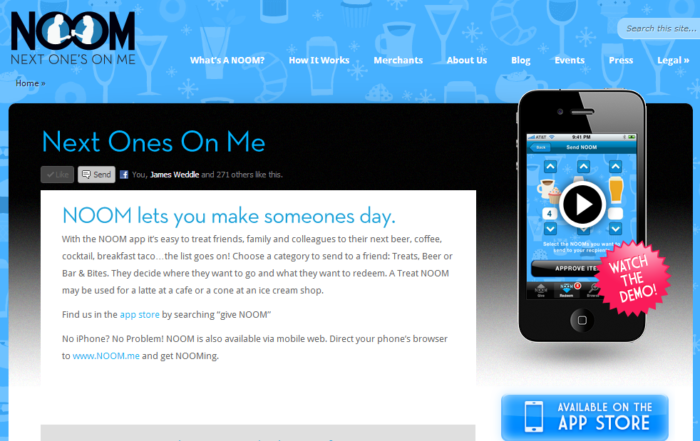
With NOOM, it’s easy to treat friends, family and colleagues to their next beer, coffee, or cocktail. They decide where they want to go and what they want to redeem. A Treat NOOM may be used for a latte at a cafe or a cone at an ice cream shop.
My relationship with NOOM is focused on market development and early stage strategy. An incredible innovation both online and off, NOOM is in the rare position of affecting change in merchant, enterprise, and consumer markets through both the platform and application that fosters real-world treating through the web.
Paul has the great ability to juggle 8 balls at once and is a jack of all trades. He is not only helpful on everything related to press, PR, marketing and social media, but has also added value by providing strategic direction/advice and even gets his hands dirty with technical development. He can be relied upon as a trusted partner and project manager.
– Jeff Schwartz; Founder of NOOM and Loop & Tie
Related Questions
Fundamentally. If entrepreneurship is a personality trait found in roughly 8% of the population, then ecosystem builders should be identifying and enabling those people; not trying to manufacture entrepreneurship through programs that treat it as a learnable skill. It also means that business owner support and startup founder support are different programs serving different populations, and conflating them produces outcomes that serve neither well.
Separate startups from small businesses in statute and policy language. Coordinate regional venture development with incubators, studios, accelerators, universities, and investors. Establish startup-specific education and curriculum — distinct from generic entrepreneurship or small business programming.
A credible market thesis, a defensible go-to-market, and a team with disproportionate ability to execute in a specific space. The product is evidence of those, not the fundable thing itself. Ideas aren't fundable. Validated market insight with a capable team pursuing it is.
Not necessarily, and this matters. Some of the most successful founders are builders, strategists, or operators who identified a market opportunity and executed against it; not personality-driven entrepreneurs who couldn't help themselves. Conversely, some of the most entrepreneurial people make poor startup founders precisely because the behaviors that define entrepreneurialism (acting without permission, pivoting constantly, ignoring convention) conflict with what scaling a company actually requires. Founder-market fit is real. So is founder-stage fit.
Policymakers, legislators, government officials, ecosystem builders, and economic development professionals, foremost; though too, it's for founders, investors, and policymakers who want scalable outcomes instead of "startup theater." If you're looking for inspiration, this isn't that book. If you want to understand why things aren't working and what to do about it, this is it.