
A couple of weeks ago I published Universities Aren’t Commercializing Innovation, They’re Taxing It with a challenge I knew would find support from most but anger from a few. Founders forwarded it privately. Economic developers chimed in with encouragement. Researchers beyond the 25 universities that benefit from commercialization sent me flowers. Intellectual property stifles innovation. And, almost without exception, the only people who disagreed were the ones whose salaries, offices, or prestige depend on the current IP and licensing regime staying exactly as it is.
I knew the pushback would come. What surprised no one was who it came from.
That matters because it proves the thesis. When a system is defended almost exclusively by those who benefit from it, you’re not looking at a debate about effectiveness. You’re looking at a fight over rents.
The original article argued something uncomfortable largely evident in startup communities: university tech transfer and IP commercialization, as practiced today, are actually not engines of entrepreneurship. They’re toll booths. They don’t accelerate startups; they slow them down. They don’t broaden access to innovation; they restrict it. They don’t reward discovery; they monetize permission. That is not capitalism. That’s feudalism with better branding.
With a chuckle at the very typical-of-credentialed assertion that I was just wrong, I decided to dig deeper because the real issue isn’t universities. It’s that our entire posture toward technology, IP, and access quietly flipped sometime around the mid-2000s and we’re still pretending nothing fundamental changed.
Article Highlights
If radio was invented today, it would be controlled by four companies and locked behind a paywall
Before we decided that owning ideas was more important than spreading them, most foundational technologies were deliberately left open, accessible, and un-ownable in practice. Not because people were altruists, but because society understood something we’ve apparently forgotten: utilitarian technologies create substantially more value when everyone can use them.
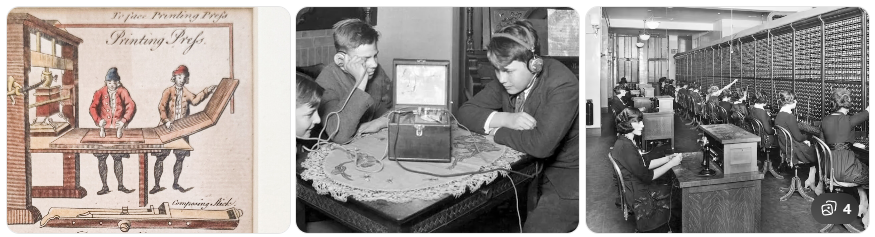
The printing press wasn’t licensed per pamphlet. Broadcast radio wasn’t restricted to approved content partners. Early television could be recorded, shared, re-watched, and rebroadcast without lawyers hovering over the living room. Telephony was fought over precisely because access mattered more than who owned the copper. The breakup of AT&T and the Bell System wasn’t anti-business; it was pro-market. Everyone understood that universal, insanely cheap access to communication was the feature, not the bug.
At the same time, we have plenty of historical examples of what happens when control wins – and we shouldn’t like the results…
Hemp paper was sidelined not because it didn’t work, but because it threatened lumber interests and newspaper supply chains. Corn didn’t become the backbone of American food because it was nutritionally brilliant; it became ubiquitous because subsidies made it politically and economically unbeatable. The automotive industry combined with the might of the airlines all but prohibited the once transformative impact of rail in the U.S. from result in any form of meaningful public transit. VHS didn’t “win” because it was the best format; it won because control, distribution, and licensing crushed competitors into submission.
No innovation victories; these were power victories.
Yet even then, society generally resisted locking down core technologies. Utilities were regulated precisely to prevent capture. Access came first. Competition followed. Innovation flourished on top of that foundation.
Then, right around 2001, we collectively lost the plot.
The U.S. government went after Microsoft over operating systems. The browser wars between Netscape and Internet Explorer weren’t really about browsers, they were about who controlled the doorway to the internet. At the time, it felt like preventing singular control; in retrospect, it was a signal flare.
What followed was not restraint, but escalation.
Innovation is Faster When No One is Allowed to Own It
Television, once freely broadcast, recordable, and shareable, became fragmented into licensed streaming fiefdoms. You don’t own what you “buy,” you rent access until the terms change. DRM turned music, games, and media into perpetual permission slips. Torrenting surfaced, and resurfaces, not because people suddenly became immoral, it’s the price of control is unreasonable to the market – causing innovators and entrepreneurs to break it.
We’re still fighting about Net Neutrality because the internet was never formally treated as a utility, even though it behaves like one. Control crept in everywhere, and the justification was always the same: protection, monetization, privacy, safety, sustainability. Pick your grounds for dictating how things work.
Now we’re watching the same fight replay in real time with AI.
AI is not a product category. It’s an interface layer for knowledge itself. It is to cognition what the internet was to information. And yet, instead of defaulting to openness, we’re racing to decide who gets to own it, license it, throttle it, or sue over it. The question isn’t whether AI should be accessible, it already is. The question is whether we will legally enable a handful of actors to decide who’s allowed to use intelligence at scale. More, how we’re allowed to use it.
If that sounds abstract, look at healthcare.
The cost of many life-saving drugs has nothing to do with manufacturing difficulty. It has everything to do with exclusivity. Single-provider licensing, regulatory capture, and insurance acting as de facto price-setters have created a system where access is rationed not by need, but by permission. Knowledge exists. Capability exists. Production exists. Access does not.
This is the same moral failure as university tech transfer, just wearing a lab coat instead of a blazer.
Treating research as licensable property rather than societal infrastructure is not neutral. It is not pragmatic. It is not even particularly profitable at scale. It is a tax on founders who could build more, on markets that could compete, on communities that could benefit, and on economies that desperately need velocity instead of gatekeepers.
Commercializing research as a control mechanism is no different than monopolizing a utility or regulating innovation into paralysis. It locks up what should be abundant. It rewards permission instead of progress. And it ensures that the next generation of breakthroughs arrives later, costs more, and serves fewer people than it should.
The defenders of this system will insist it’s necessary, for quality, for incentives, or for sustainability. They said the same thing about phone lines, broadcast towers, operating systems, and file sharing. They were wrong then, and they’re wrong now.
A good question isn’t whether universities or governments can own innovation, it’s whether they should, and what kind of economy we have since they do.


The hardest part isn’t solving the problem; it’s translating reality into language that preserves existing power structures.
I’ve seen this pattern repeat in founder support just as clearly as in healthcare: systems don’t just lock up knowledge, they lock up the conditions required to act on it… execution itself.
Control gets mistaken for value. Translation gets mistaken for progress.
What once passed as well-intended but clumsy “help” has evolved into something more deliberate.
You’re so right: it’s enclosure with sneakier branding.
Unicorn-architect minds aren’t sheep. An execution economy built on accessible relevance is inevitable. The real impasse is sustainability, and the blueprints can’t come from the center anymore. They have to originate with lived-experience minds at the margins; where cognitive labor and extraction currently keep people trapped in survival mode, by design.
That’s where the next correction is forming.
Innovation occurs when truly novel IP is created. This doesn’t happen all that often. It also occurs when people engineer solutions by going around existing IP. I would argue that most startup companies have no idea how many patents they are violating (how could they) & it only becomes an issue if & when you become successful.
What we need is patent troll legislation. You shouldn’t be allowed to enforce a patent unless you are actually using it in a legitimate commercial capacity & can prove that your competition is materially benefiting from using the IP to compete against you (maybe an 80/20 rule, the infringed IP is 80% of the overall solution). You should also have to prove that you created the IP before they started using it in a commercial capacity.
I would also like to see a “Common Good” designation for some IP that could benefit society as a whole. Bottom line, the Government could use something like eminent domain to designate specific IP as a Common Good.
What else am I missing?
This is a very insightful post and very timely for Tulsa and Oklahoma. But I would suggest Tulsa is better centered on defense cyber, energy innovation and autonomous air mobility.
“AI is not a product category. It’s an interface layer for knowledge itself. It is to cognition what the internet was to information.”
So much depth here.
Fatin Kwasny thank you! The increasing control and limits on AI are troubling – it can only mean someone decides what’s allowed.
If we can’t create silos around knowledge then we can’t create silos around wealth
the system of Innovation needs to be changed.
Paul, you are my new best friend! You have the guts to say what I think about – and the time to research it and put it in perspective. I am going through an IP process now with the iLean-Pan to protect my design, and you are 100% right: to find the right people that charge for their time in a way that was doable was a real challenge. Even getting clarity on whether I needed an IP path – was dubious – everyone who’s works in it was adamant about it and scared me about big risk. Everyone who says go to market fast like – lean startup gurus say – skip it who knows if your idea will hit and why spend money on something that might never really come to fruition – but the cost of being wrong here can be real problematic. It’s a founders conundrum.
Ilene Marcus it is a conundrum
I’m finding that I’m becoming the internet version of “get off my lawn!”
Intellectual Property isn’t about protecting corporate interests, it’s about protecting value created through human effort. When we remove the IP as concept that we get to own what we make, it opens the door to new dysfunctions. Yes, rent economy is extractive, but take economy will be worse. Why not recognize a Proof-of-Value (PoV) model, where people still get to build on top of IP but with proper attribution and profit-allocation.
Ramona Tudorancea it’s not a take economy when people appreciate that ideas aren’t proprietary or ownable.
When only those who benefit from a system rush to defend it, it’s often a sign the system needs re-examining, Paul O’Brien
Applying mature-market tools to immature knowledge almost always slows innovation.
Jonathan Marshall
Cc Lionel Kabeya Katshinga