
This is one of those articles that you don’t really want to write but you know needs to be written. An observation that will frustrate some, anger others, and more likely than not, draw ire toward me because there is no way to point this out without criticism, here we go. Grab yourself a cup of coffee, find a comfy chair, and then read on with an understanding here that I’m just a messenger, and this is a message that everyone needs to hear so that we can raise expectations, better allocate capital, rethink public policy, and work together from a place of known best practices to ensure our entrepreneur class isn’t struggling when it need not be.
If you’ve spent any time in startup ecosystem development, you’ve heard some version of the sentence: “We need an accelerator.” I heard it today in fact, in a discussion of a small town in Missouri, that some there too think they need a startup accelerator.
City councils say it. Economic development offices say it. MPs and ministers say it, usually right before they approve a grant and cut a ribbon in front of a glass building with exposed brick and a ping-pong table. The UK has been saying it, and funding them, for long enough that the country now holds a distinction nobody seems to be talking about in any meaningful way other than pointing it out: according to the Entrepreneurs Network’s July 2025 report, Full Speed Ahead, Anastasia Bektimirova and Steve Rigby note that Britain is the world’s most heavily incubated economy per capita. Cate Lawrence and Philip Salter, Founder of The Entrepreneurs Network, took a closer look noting in Tech.eu that the UK hosts over 500 accelerator programmes, with £219 million invested through Innovate UK alone since 2016.
I’ve quickly come to respect angel investor Susan Montgomery, whose brevity and clarity brings reason to social media; she has backed 13 unicorns from seed contributes to all that we’re trying to improve by writing about how capital actually works at her Substack, She writes for founders who don’t yet know what they don’t know, and the picture I saw her paint of the UK’s early-stage support infrastructure is something between admiration and concern. The UK’s tax incentive architecture for early-stage investment, via SEIS, the Seed Enterprise Investment Scheme, and EIS, the Enterprise Investment Scheme, keeps catching my attention as she writes about it because her various concerns often align with my own. She often asks, I’m paraphrasing, “Is it working?” Perhaps, is the accelerator ecosystem we’ve built throughout the world, in cities everywhere, often built on grants, tax incentives, and public funding, producing the results we should expect from that investment?
I’m fond of asking cities if their accelerator is actually accelerating. This year, the responses are resoundingly consistent, increasingly frequent, and alarming to say the least, “Our accelerator is little more than coworking space with office hours and events.”
So, with such density in the UK, we have an opportunity to explore this with a little more clarity. Not whether Britain’s intentions are good. They obviously are. The question is whether a high density of programs labeled “accelerator” produces a higher density of outcomes that justify that label.
By almost every available metric, the answer is no.
Article Highlights
- Density Without Direction Is Just Real Estate
- The Incubator-Accelerator Confusion Is Not an Accident, It’s a Policy Failure (or political pandering)
- £219 Million Is Not Nothing. What Did It Buy?
- What Acceleration Should Require and Expect
- The Metrics Problem Is Actually the Accountability Problem
- Call It What It Is
Density Without Direction Is Just Real Estate
First let me share why this can’t be ignored. Most cities have an accelerator now, many have two or more. To a great extent, they’re celebrated, revered, promoted, and home to celebrity photo shoots where the mayor wants to show off that they’re being innovative and supporting entrepreneurs.
Obviously, with such programs in place, we can expect a rate higher than average of successful startups.
At the very least, an accelerator is doing due diligence to pre-qualify developed startups to ensure they are worth being accelerated. That alone should result in a success rate greater than 1 in 10. Moreover, we don’t accelerate an idea or a founder with a dream, that’s ludicrous, we accelerate that which is ready to go, bringing to bear partnerships, media attention, and investor meetings primed to write checks; the validation work is done, the MVP is iterating to more, and the business model is being worked out. Or perhaps in fairness, if an accelerator is taking in idea stage founders, it would be “accelerating” the testing and helping founders find failure more quickly, resulting in less waste, and in turn still, more success.
With one accelerator in a city, barely disclosing metrics, it can be hard to tell if it’s delivering. We can look to local sentiment, which already noted, seems to be gravitating toward, “these aren’t working for us,” but a direct analysis is challenging. At the scale of a country though, with much more economic data available, we have a responsibility to dig in.
When you compare the UK’s startup ecosystem to peer economies of roughly similar size and development, a strange pattern emerges. Germany, France, Canada, and Australia all run broadly comparable startup success rates. Spdload’s startup failure statistics compendium puts UK’s 5-year failure rate at roughly 70%, Germany’s at 75%, France’s at 80%, and Canada and the US each around 80%. On that face, the UK actually looks quite a bit better given the conventional wisdom that 90% fail. Its success rate, at roughly 30% over five years, outpaces France and Canada and that would strike me as remarkably better than the U.S. perception of success rates.
Still, is it working? The UK is spending dramatically more than any of those countries on accelerator infrastructure to produce that edge, making me ponder something I frequently ask about, “are these actually startups or are we launching businesses?”
We’ll get to that.
Switzerland runs a 65% failure rate, meaning roughly 35% of startups survive five years; it achieves that without anything resembling the UK’s accelerator volume. Israel, which has earned its “Startup Nation” branding through decades of deliberate, selective, strategy-linked ecosystem investment, runs comparable figures with far higher precision and intentionality.
Now, hold on a second. That’s remarkable. I have a moral responsibility to the founders who follow me to give you the best conceivable advice, “move to Switzerland!” To heck with Lean Startup, Go To Market advisors, and Venture Capitalists’ opinions, Switzerland figured it out!
And yet, neither country achieved better-than-average startup survival by funding 500 accelerator programs and hoping the outcomes sorted themselves out; they got there through specificity, sector depth, and a relentless, something I preach about, very intentionally preach, in the book, Startup Ecosystems… often there, with a ruthless commitment to asking whether what they built was actually working.
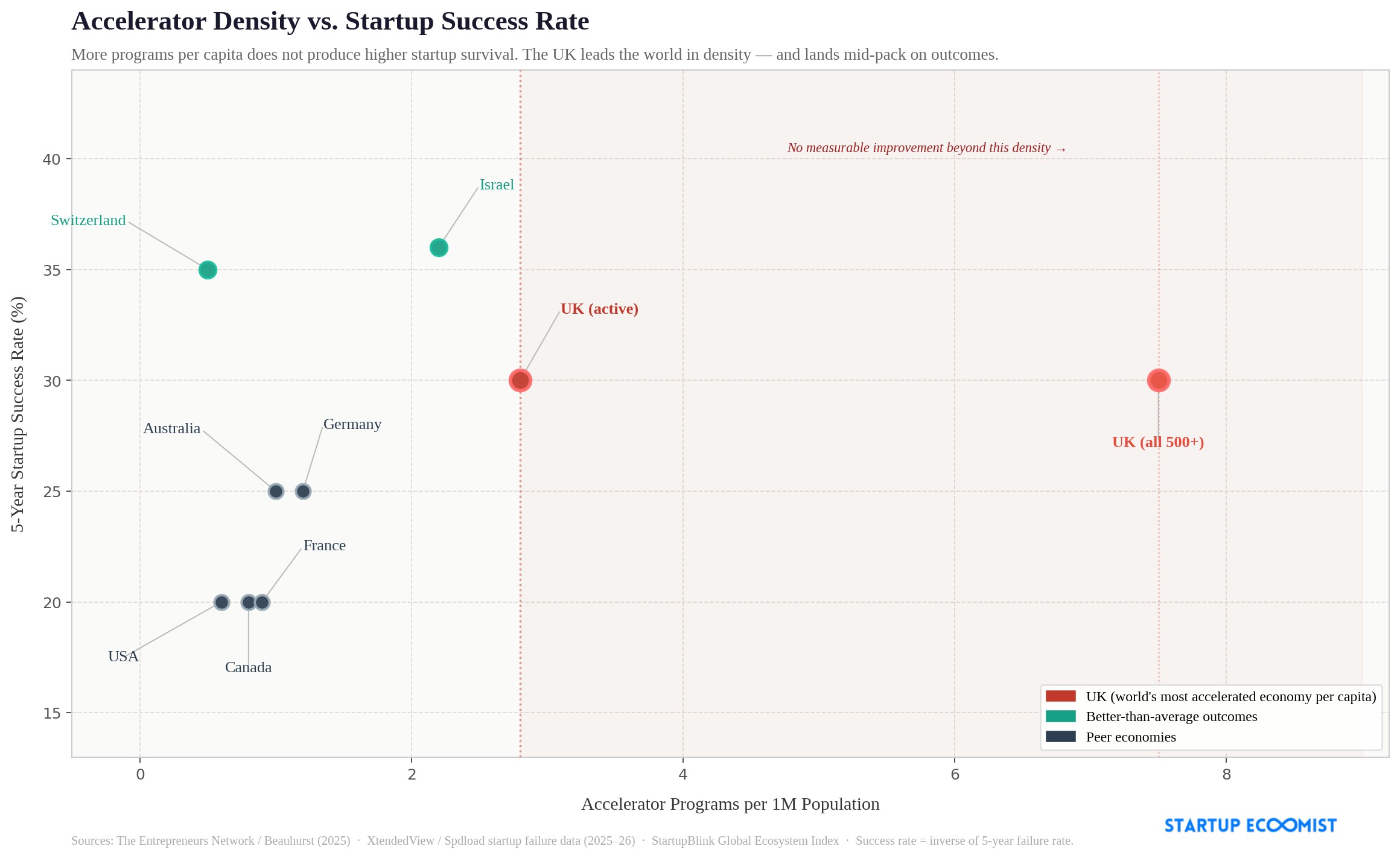
The chart I put together above captures some of what we should be studying as cleanly as I can get at the data.
And then I saw it. Did it catch your attention? The U.S. startup success rate plotted is 20% while the conventional wisdom is 10%. Something doesn’t smell right.
There is a methodological problem sitting under every number in this comparison because it makes the UK’s position look better than it probably is. The failure rate data cited for the UK, Germany, France, and the rest draws from government business registration datasets, primarily Bureau of Labor Statistics-style business employment dynamics reports and their international equivalents. Those datasets generally include all new businesses in the startup category: new franchises, a barbershop, a florist. They are initially small and new companies, but they do not necessarily have disruptive or compound growth options.
Perhaps you’re seeing more clearly why I harp on our needing to draw these distinctions. A startup is “a temporary organization designed to search for a repeatable and scalable business model” which, by implication, a barbershop is not. Or fine, if everyone wants to co-opt the word startup, then we need a new distinction of everything that isn’t just a new business; I don’t care what we call things, they’re not the same.
Failory, which runs one of the more rigorous failure-rate tracking operations, is explicit about the contamination problem: “Statistical sources from government institutions are largely concerned with the failure rate of new businesses… Most newly registered businesses aren’t true startups, so you shouldn’t assume your likelihood to fail in the first year is only 20% if you’re trying to do something innovative. Some articles out there are quoting those statistics in the context of startups, which is misleading.” When the Bureau of Labor Statistics reports that only 20% of US businesses fail in year one, that denominator includes dry cleaners, tax preparers, and restaurant operators who signed a known playbook on day one. The per-country comparisons used throughout this piece carry the same contamination: they compare new venture registrations, not scalable startup formations. The UK’s 30% five-year success rate certainly includes a substantial volume of service businesses, sole traders, and lifestyle companies that have nothing to do with what the accelerators are supposed to be accelerating. Strip those out and the true scalable-startup survival rate in every country on that chart drops; the relative performance of each country may or may not shift, but the UK’s apparent advantage over Germany and France almost certainly compresses. The chart still holds as a directional argument. The point it makes, that the density of accelerator programs produces little improvement in survival rates, is not weakened by this caveat. If anything, it is strengthened: if the UK’s headline numbers include a high proportion of non-scalable (ahem, nothing to accelerate) new businesses padding the survival count, the programs that claim to be accelerating scalable ventures are performing even less impressively than the aggregate figures suggest.
The appearance of ecosystem activity is a dangerous thing because the appearance satisfies the political requirement without satisfying the economic one. Founders don’t fail demo days in accelerators; they survive or fail customers.
The Incubator-Accelerator Confusion Is Not an Accident, It’s a Policy Failure (or political pandering)
Here is where the conversation gets awkward but I get fired up because pointing out that most accelerators aren’t accelerating anything requires you to also explain what accelerating would actually mean, and most of the people running programs would prefer you didn’t ask.
So, let’s reiterate it.
An accelerator, in the original sense that Y Combinator proved in 2005, takes a startup that has cleared the basic existential questions, meaning it has a product concept, a founding team, and at minimum a hypothesis about a customer, and then applies intensive, structured pressure around the three things that determine whether that startup survives the next 18 months: marketing and customer growth, partnerships and distribution, and capital access. Not workshops about those things. Not panels featuring people who have opinions about those things. Actual execution: introductions to customers, not just investors; earned media coverage, not just pitch prep; term sheets, not just “office hours with a VC who might be interested someday.”
That is a narrow, demanding, operationally intensive job. It requires the people running the accelerator to have specific, current, credible experience in the domain where they’re accelerating. A fintech accelerator needs people who have sold into banks. A healthtech accelerator needs people who understand NHS procurement. A deeptech program needs people who know how to bridge from lab to Series A without burning the founder. University programs, discussed in a conference in which I just found myself, have an obligation to actually commercialize IP and not just “tech transfer” otherwise they are being irresponsible in claiming to develop entrepreneurs and startups. Most accelerators fail founders precisely because they are running education programs for pre-idea founders under a label that implies they are scaling post-product companies. They take on anyone, they celebrate cohort size, they give lectures on marketing fundamentals to founders who should have cleared that bar before applying, and they call it acceleration.
How can we possibly support so many “accelerators” in the UK unless most are actually, per the operational reality, a combination of coworking infrastructure, some education, and networking events? Those are coworking spaces. Good spaces, maybe, perhaps with a hint of an incubator, but neither accelerator nor specific to startups. The distinction here are critical, and it matters not because one is superior to the other, but because they serve founders at entirely different stages while only capably doing so when it’s clear if it’s a program for a business or a startup. Labeling an incubator as an accelerator and then funding it with public money under the assumption it will produce accelerated company growth is like hiring a tennis coach, having them only teach nutrition fundamentals, and then measuring their success by whether your improved lap time in the pool.
What the UK provides, and I really feel bad for pointing this out in a way that will sound like criticism, is the most glaring impact of misuse of programs, expectations, and the malignment of resources and experiences. It’s not in the UK that my goal was to be critical, it’s for all that I hope these observations help you fix this for founders!
The challenges in UK accelerator provision, as ChangeSchool London MD Viren Lall observed at a roundtable convened around Full Speed Ahead, aren’t about a lack of resources but about misaligned incentives, fragmented delivery, and fundamental questions the ecosystem has avoided asking. A dominant theme was the VALID assumption that all 860 incubators and accelerators across the UK should be optimized for high-growth ventures but that’s a valid assumption only because that’s where those programs apply. In this case, we don’t have 860 incubators and accelerators, they can’t, we have coworking spaces, startup hubs, small business development centers, and innovation districts with, we should fear, a mix of business and startup founders, advisors, and mentors, diluting quality throughout.
Moreover, the problem we all face isn’t just that calling all of these startup programs “accelerators” creates an expectation on the founder’s side that isn’t being met, it’s that it creates a public accountability gap on the government’s side that nobody is closing.
£219 Million Is Not Nothing. What Did It Buy?
Between 2016 and today, £219 million has been invested in accelerator programmes through Innovate UK alone. The questions that should persist for everyone in every city, everywhere, are about effectiveness, strategic alignment, and return on investment. Outcomes not impact. Despite such investment, it would seem there is limited coordination of how these funds are allocated and patchy strategic oversight of what outcomes they achieve and how these programs fit into the wider ecosystem of advisers, funders, and other parts of the economy.
For context, £219 million is approximately what Sequoia Capital invests in a moderately sized fund. It is not trivial.
And yet what it has produced seems to be more a proliferation of programs rather than a proliferation of outcomes.
Here’s a note of progress with which to call your attention to something else that should appear odd in my chart. Most of the data I’m referring to is a year or more old. Things have changed. Beauhurst data cited in the Full Speed Ahead report shows that nationally, only 57% of listed incubators or accelerators are active, with 33% since closed, and 10% are in a state of limbo. That’s why you see an indicator for the UK way out there on the right, and then too, closer with the other countries. But it still warrants showing you how things were, because again largely throughout the world, people like me are hearing that “accelerators are not working,” and I’d rather stress to you that you need to check on that, than worry about the minutiae. Think about that for a moment: one in three UK accelerators received public funding but no longer exists (granted, probably shouldn’t, but still received the funding!). One in ten is, charitably, not sure if it exists. And the founders who signed up for programs that subsequently evaporated? Presumably, in limbo.
Steve Rigby, Co-CEO of Rigby Group, warned that “public funds should not be used to generate more of the same programmes but should instead focus on creating fewer, deeper, outcome-linked programmes and only where it genuinely adds value, rather than crowding out private capital.”
This is not a criticism of the founders and program managers who built these things with genuine conviction!
Most people who run accelerators are not charlatans; they are people with good intentions and inadequate feedback loops. The rub is that the government grants that fund them rarely require proof that startups actually grew faster, raised capital, or survived longer than startups outside the program while the policymakers who allocate funds rarely know if those good intentions are matched with experience and know-how. They require proof of activity: cohort numbers, mentor hours, demo days attended.
People increasingly say, “our accelerator isn’t helping,” because public funding allocated to people with good intentions who then sell the ideal of an accelerator to business owners and would-be founders alike, are not likely helping anyone. An accelerator that produces 40 LLC filings, but zero Series A rounds has not succeeded; it hosted a workshop.
Comparing UK Outcomes to Comparable Markets
Germany makes for an instructive comparison.
With roughly 1.2 accelerator programs per million people (compared to the UK’s 7+ per million when counting all 500 programs, or roughly 2.8 per million counting only the active ones), Germany achieves a 25% startup success rate. The UK achieves 30%. That five-point edge over Germany exists despite a German startup ecosystem that by many accounts runs deeper domain expertise, stronger corporate-to-startup partnership infrastructure in sectors like automotive and industrial tech, and a longer-standing culture of serious engineering as a foundation for venture development.
Still, those can’t be actual “startup” metrics but the comparison and contrast becomes much clearer despite the mix of entities.
France, which has invested heavily in its La French Tech initiative and has a more deliberate public-private startup infrastructure than is often acknowledged, still lands at roughly 20% success; it runs fewer programs per capita than the UK but invests more per program in specific verticals. Canada and the US sit at that 20% figure with dramatically lower accelerator density. The US, the country that invented the modern accelerator through Y Combinator, Techstars, and 500 Startups, runs somewhere around 0.6 accelerator programs per million people, against the UK’s 7.5. U.S. startup success rate, in this data, is roughly equal to France’s.
Regardless of what’s going on, we don’t have encouraging numbers for the theory that accelerators, let alone more of them, are doing their job.
Israel’s ecosystem is the relevant counter-example because we could characterize their economy as an example of startup integration. Military technology pipelines produce technically sophisticated founders early. Government R&D investment is co-designed with VC infrastructure from the beginning, not layered on top afterward. Accelerators in Israel are predominantly sector-specific, narrow, and run by people with direct operating experience in the domain. The result is a startup success rate that outperforms most comparable economies. The lesson is not that Israel built more programs; it is that Israel built fewer, better-integrated, more accountable ones. I’ll explore Israel in detail in the future but what’s evident already is knowing this is an ecosystem design question, not an enthusiasm question; one explained in Startup Ecosystems.
What Acceleration Should Require and Expect
The startup has a product.
With evidence of customer interest, not just customer curiosity, we have something to accelerate. With a team that can execute, we have a reasonable use of funding; without that team, we need an education program or coworking space. What an accelerator needs to provide is not a workshop on product-market fit since the startups should *have* that. What it needs is distribution: relationships with the first ten customers who matter, access to the distribution channels the founder can’t open alone, introductions to journalists and analysts who cover the space, and warm connections to investors who have already backed comparable companies. That is marketing and growth in its functional form, not its theoretical one. It also needs partnership access, meaning the corporate or government or channel partners whose endorsement or integration would transform the startups’ credibility. And it needs capital access, not “we can introduce you to our network of VCs” (which I can do with LinkedIn and my gmail) but “here is the specific partner at the specific fund who has deployed capital into this exact problem in the last 24 months.”
Three requirements: marketing-driven growth, partnership development, and direct capital access, are what distinguished an accelerator from everything that came before it in the ecosystem. Most UK programs, per the evidence, are delivering something closer to education and community, which is valuable, genuinely, but it is not startup specific and it is not acceleration. Angie Mahtaney, Principal at Aroundtown, told Tech Funding News: “Accelerators should not just be about fast-tracking fundraising, they should focus on deepening founder capabilities and helping entrepreneurs understand how to navigate complex, highly regulated industries.” That framing is more honest than most, but I want to nuance it a bit if I may because “accelerators” should absolutely fast-track. Agreed, they should not just be about fundraising, but fast-tracking growth, partnerships, and capital? Yes. On the other hand, incubators, founder development programs, venture studios, and classes deepen capabilities.
Most cities don’t have an accelerator. That they call it one is irrelevant.
The Metrics Problem Is Actually the Accountability Problem
Philip Salter, founder of The Entrepreneurs Network, said: “The UK has plenty of startup support programmes, but we don’t always know if they actually work. Founders can’t even be sure these programmes will still exist before they finish. We need reforms that make programme outcomes transparent and reward schemes that create lasting impact.” That framing is exactly correct, and yet it understates how deep the structural problem runs throughout the world.
The issue is not just that outcomes aren’t measured; it is that the incentives are misaligned at every level. The government body that funds accelerators is measured on deployment, not return. The accelerator that receives the funding is measured on cohort size, not company survival. The founder who enrolls is measured on participation, not growth. At no point in this chain does anyone’s performance metric actually correspond to whether startups improved their odds of survival, raised capital, found customers, or built companies that lasted.
What we too often have is policy theater, not policy infrastructure, and thanks to the UK, we can see the cost of that in extremes so that we might better appreciate the implication everywhere.
What’s more difficult to discern but equally important is when we have a program seeking funds, claiming to be an accelerator, and our decision makers are incapable of discerning if they’re capable. This doesn’t mean we don’t dismiss the intention to start an accelerator, it means we need to be establishing outcome based metrics so that the accelerators that we have, and those which emerge, deliver, discern themselves correctly, or disappear.
What should be measured instead? The answer is not complicated; it is simply uncomfortable for programs that are not delivering, and those programs have historically been louder in policy conversations than the ones that are. Meaningful accelerator outcomes include:
- Whether companies raised follow-on capital at a rate higher than the baseline for startups outside the program
- Whether revenue growth in the 12-18 months post-program outpaces sector averages
- Whether founders remained in the ecosystem and went on to found subsequent ventures
- Whether the program’s alumni survival rate at three and five years exceeds the national baseline
If your accelerator cannot answer those questions with actual data, it is not an accelerator; it is a community event series with better branding.
Salter added to my push that, “We also need a better understanding of impact. Success is often measured by immediate startup outcomes, but this can miss the longer-term development of entrepreneurial talent. Tracking founder progress over time, including across several ventures, can provide a more meaningful picture of what impact support programmes have.” That is a sophisticated position, and it acknowledges something startup ecosystems largely avoid: that founder development is a multi-year, multi-venture process, not a 12-week cohort. A founder who goes through an accelerator, fails, learns, and builds a second company that succeeds is a program outcome. Most current metrics would count that as a failure.
Call It What It Is
Here is the part that will annoy some people, if I haven’t already (hey, I never said I was kind at the expense of being nice): the honest answer to this problem is not that the UK needs to shut down its incubators and coworking spaces. Everyone needs to stop calling everything an accelerator. Incubators are real, valuable infrastructure. Coworking spaces with programming create genuine community. Office hours with experienced practitioners provide real value to early-stage founders. None of that is the problem. The problem is the label, because the label creates an expectation that the program isn’t delivering and doesn’t intend to deliver.
When a founder walks into a program that calls itself an accelerator and gets educated on finding product-market fit, that founder has been misled, however gently. They went in expecting distribution, capital access, and growth partnership, and they got a curriculum. No… they went in deserving that. The mismatch is not malicious; it is systemic. In the broader analysis of why accelerators fail founders, the problem shows up everywhere from Boise to Brussels: “participation is celebrated (it looks and feels good to appear to be trying) while the outcomes that matter to founders — funding, or at least accelerated growth — are ignored.”
The UK’s ecosystem is not failing on intentions. It is not failing on enthusiasm or even on investment. It is struggling on design. A country that has deployed the world’s highest per-capita density of startup support programs and produced startup survival rates indistinguishable from Canada and France has demonstrated, empirically, that program volume is not the variable that matters. Program quality, specificity, accountability, and outcome design are the variables. Every serious ecosystem builder has known this for years. The Full Speed Ahead report knows it. The Beauhurst data confirmed it. The only question is whether the institutions holding the grant funding will act on it or go on funding the same programs under different names until the next report asks the same questions.
The Entrepreneurs Network has proposed a reasonable path, one I’ve argued for as well for decades: establish a classification taxonomy so that incubators, accelerators, and coworking programs are labeled accurately; tie public funding to outcome metrics, not activity metrics; replace annual grant cycles with three to five year outcome-linked contracts; and give founders vouchers they can redeem with accredited programs, shifting demand power to the people the programs are supposed to serve. These are not radical ideas; this is basic accountability infrastructure. The fact that any of this reads as reformist or even criticism, is a statement about how low the bar has been set.
Ben Cousens, Co-Founder and CEO of Antidote, “There’s a lot of talk about a ‘failing UK startup scene.’ The truth is, the UK isn’t failing, it’s drifting. The talent and capital are still here, but the confidence has gone.” Drift is an accurate description. Britain has a world-class early-stage investment framework in SEIS and EIS. It has London, which remains Europe’s most significant startup hub by most measures. It has Seedcamp, with 10+ unicorns in its portfolio, and Entrepreneurs First, and Founders Factory, and a handful of other programs doing real acceleration work. The infrastructure for a genuinely high-performing startup ecosystem exists. The problem is that it gets diluted, in public perception and in public funding, by 500 programs, a third of which have already closed, calling themselves something they aren’t.
What you’re struggling with in your own ecosystem, whether it’s London or Leeds or elsewhere several time zones removed, probably looks something like this: You have programs, you have funding, you have founders going through cohorts and coming out the other side with and without the customers, capital, or growth rate that “accelerated” implies. The question to ask is not whether the program was well-intentioned; it was. The question is whether it was honest about what it was, what it could deliver, what it did deliver, and what it expected of itself. If those answers aren’t grounded in measurable outcomes, the program isn’t an accelerator; it’s infrastructure in search of a purpose. That’s not a condemnation, it is a starting point.

People get very offended when you ask about how accelerators should be compared and ranked especially when it comes to ROI
It’s not about how many casinos you build, it’s about how many successful gamblers you produce.
Steve Jennis in a sense, yes. Though more to my point here, stop calling the video game arcade a casino.
How dare we say they’re NOT something they’re not LOL
Paul O’Brien If you’re measured on the number of ‘casinos’ you build it’s tempting to call everything a casino.