
The research isn’t vague anymore. Decades of behavioral economics, psychology, and entrepreneurship studies have piled up enough evidence to stop pretending success is random. Whether someone builds alone or inside a founding team, outcomes track to a small set of repeatable human behaviors. Put the right skills and habits inside a young organization and it compounds. Miss them, and no amount of hustle theater, demo day pitches, or motivational posters saves you.
That matters because we finally know how to serve entrepreneurs better. I’ve written extensively about what separates founders who build durable companies from those who burn time and capital, pulling from personality research, venture outcomes, and ecosystem data. Academic work, including research coming out of Oxford University and aligned institutions, keeps reinforcing the same point: certain traits correlate strongly with entrepreneurial success, while others do not. Risk tolerance, openness, internal locus of control, and conscientious execution show up again and again in the data. Society is slowly learning that helping entrepreneurs doesn’t mean telling everyone they’re equally suited to founding a company. This means encouraging people to try, teaching them the methodology, and then helping those without certain traits partner with or co-found alongside people who have them.
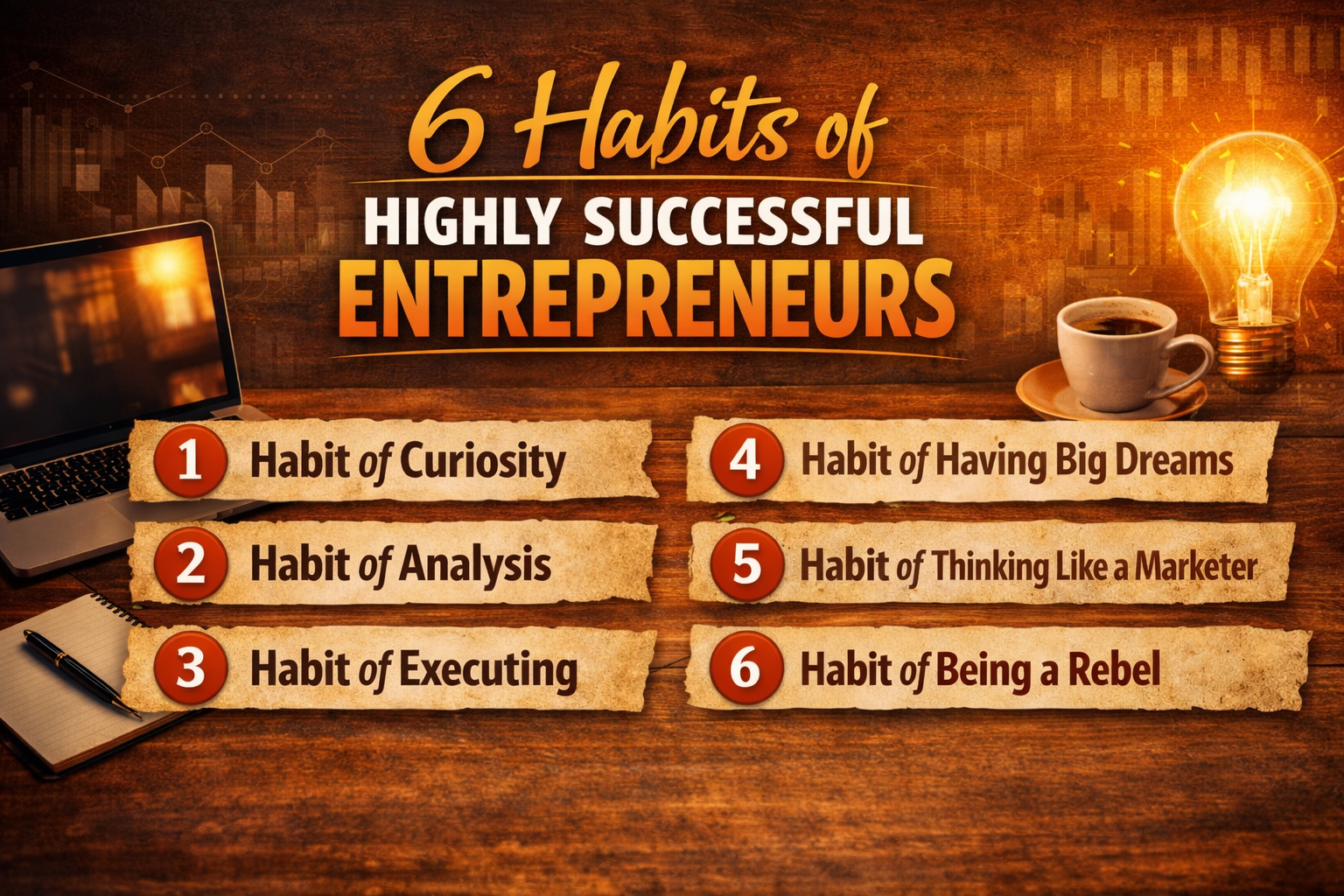
Personality, risk appetite, and cultural wiring are stubborn. We can’t reprogram them with a workshop. That tension weighs on startup communities: be welcoming and inclusive without lying to people about odds (for example, the conventional wisdom that 90% of startups fail is misleading – we know that the average age of success is 44 which means, like it or not, if you’re 20 or 60, your odds of success are much lower than that of a 40 year old starting a company). The good news is that habits are different. Habits are trainable. They don’t overwrite who you are, but they do determine how you behave when it matters. The founders who win develop the same six habits, consciously or not, and then repeat them until they look like instinct.
Before I go on, some credit where due, Hector Quintanilla identified these Habits of Highly Successful Entrepreneurs almost a decade ago and here, we’re going to explore them further (Hector, there is a book here)
Article Highlights
1. The Habit of Curiosity
Entrepreneurship begins with irritation; most see this the wrong way, orienting people to opportunity, self-employment, or starting a business, encouraging effort in possibility when what’s required is determination. Curiosity is the refusal to accept that the way something works is the way it must work. Every strong founder I’ve met has a low-grade obsession with questions that most people don’t bother asking. How could this be faster? Why is it so expensive? Who actually makes the money here? Why does everyone tolerate this friction?
Curiosity isn’t abstract, it’s practical nosiness. It’s standing in line and reverse-engineering margins. It’s using a product and mentally redesigning it while everyone else scrolls. Think of curiosity like a muscle that tightens every time you encounter inefficiency; over time, it becomes automatic.
You develop it deliberately by slowing down your consumption. When you buy something, ask how it’s made and shipped. When you subscribe to software, sketch the sales funnel in your head. When you see a company raise money, ask what problem investors believe is being solved. Keep a running document of questions that annoy you. I write, less so to share or teach and more so because I’m curious how you all will react. Most startups begin as a single unanswered “why is it like this?”
2. The Habit of Analysis
Curiosity without analysis is just opinion. Entrepreneurship demands the discipline to turn questions into numbers, tradeoffs, and constraints. Analysis is where fantasy gets murdered early, which is a mercy, not a flaw (when people criticize your startup meaningfully, it’s a kindness from an analyst who knows).
Serious founders model reality before it models them. They ask what manufacturing actually costs, not what they hope it costs. They pressure-test pricing against payroll, taxes, and customer acquisition, not vibes. They care about market size because small markets cap outcomes no matter how clever the product.
This habit is developed by learning to enjoy spreadsheets and analytics the way artists enjoy canvases. You don’t need an MBA, but you do need fluency in unit economics. Start by breaking every idea into inputs and outputs. Revenue drivers, cost drivers, time drivers. Force yourself to quantify assumptions, even badly. Precision improves with repetition. Avoiding analysis doesn’t make risk disappear; it just blinds you to it.
3. The Habit of Executing
Ideas don’t fail; people fail to act on them. Execution is the least romantic habit and the most decisive. The difference between a dream and a company is a calendar filled with risky actions taken.
Execution looks boring up close. It’s deciding what happens today and doing it even when motivation evaporates. It’s shipping something imperfect instead of polishing a concept forever. It’s understanding that activity is not progress and busyness is not effectiveness.
You build this habit by shrinking the gap between decision and action. Write down the next physical step required to move forward, not the ten after that. Make commitments public so accountability isn’t optional. Track your time honestly. If fear, comfort, or distraction keeps showing up, name it because it’s not teaching you to play it safe, it’s getting in your way. Execution improves when excuses are treated as data, not character flaws.
4. The Habit of Having Big Dreams
Entrepreneurship without a real dream collapses under pressure. The dream isn’t about money. Money is a scoreboard, not the game. If wealth is the only motivator, a high-paying job beats startup stress every time.
Big dreams function like gravity that pulls you out of bed when conditions are bad and validation is absent. They answer why this pain is worth enduring. Strong founders can articulate their purpose clearly, even if the language evolves over time. This is often evident in a founder when they’re fixated on a problem, not their solution.
You develop this habit by interrogating your motivations ruthlessly. Ask why this problem matters to you specifically. Ask what kind of world exists if you succeed. Write it down and revisit it when things stall. Dreams don’t have to be grandiose, but they must be personal. Borrowed ambition dissolves quickly.
5. The Habit of Thinking Like a Marketer
Entrepreneurship is selling, whether you like that word or not (frankly, as my peers know, I don’t like it). But be clear that as a startup (and so many of you still ignorantly argue with me about this -> a startup, not a new business), selling is not about customers! You sell ideas to co-founders, belief to employees, confidence to investors, opportunities to partners, and solutions to potential customers. Marketing isn’t promotion. It’s understanding how people decide and designing around that reality.
The best founders obsess over their market which is far more than who buys. They learn what triggers action, what creates trust, and what removes hesitation. They understand that features don’t sell; outcomes do. They know distribution is often more defensible than technology. Society, in 2026, is finally waking up to the immeasurable value of storytelling and you lack this habit, you’re severely disadvantaged.
This habit is developed by studying human behavior, not slogans. Read classic marketing research. Watch how people actually buy, not how they claim they buy. Practice writing simple explanations of what you do that a stranger understands in one sentence. If you can’t sell the idea, the product won’t rescue you.
6. The Habit of Being a Rebel
Entrepreneurship is leadership without permission. Following the crowd is safer, but it never produces asymmetric outcomes. This reiterates that distinction I demand with veracity of a startup from a new business – you’re not a business owner, you’re a rebel. Every successful startup founder carries a quiet rebellion against “the way it’s always been done.”
Being a rebel doesn’t mean being reckless. It means developing convictions and acting on them even when consensus disagrees. Markets reward those who see differently and act earlier, not those who wait for validation.
You develop this habit by resisting reflexive agreement, question defaults. Build a point of view and stress-test it against evidence, not approval. Surround yourself with people who challenge you instead of comforting you. Leadership emerges when you’re willing to be temporarily wrong in public in pursuit of being eventually right (hell, subscribe to or follow me, you’ll see I’m wrong all the time! Or at least, willing to stir controversy to change norms).
None of these habits require permission, pedigree, or a specific personality profile, they require practice. Startup ecosystems that understand this stop pretending success is mystical and start building environments where these behaviors are taught, reinforced, and modeled. The real question isn’t whether you’re cut out for entrepreneurship in some abstract sense. It’s which of these habits you’re strengthening right now, and which ones you’re quietly avoiding.


Thanks for sharing, my friend!
I really miss the days when Quora was a lively, thriving community.
Hector Quintanilla keeping the dream alive!
Great stuff (as always)! Paul O’Brien
a keystone topic. I’ve been literally laughed at over too many of my dreams. My deficiency is in the habit of being a rebel.
Mark Jensen that’s where, I think, that habit of curiosity and that habit of a marketer needs to dominate. I’m happy to be laughed at… I’m even happier when I prove the detractors wrong
No argument with any of these Paul, but as a recovering product management guy, seeing curiosity as #1 on the list hits just right.
In addition to being essential characteristics of an entrepreneur, I would argue that these are also the characteristics you want to see in your early adopter customers. If you’re launching a product, at a startup or a legacy player, a curious customer with big dreams is exactly the type of high achiever that will take a risk on a new product idea. People who are not curious and who are comfortable with the status quo, do not make a good early adopters customers, but I see startup founders chasing them simply because they work for a company with a logo they want to add to their website and pitch deck.
I even wanted to push further, that curiosity is not HOW to do something or figuring out if you can… it’s not being curious enough to start a business – it’s being curious about how to change everything.
I’d like to see resources for each of those 6 points. Insightful post though! Thanks!
happy to dig deeper! define resources for me…
Do you mean tools or platforms to help? Articles or books about them? Research?
While it is typically assumed that people heavily underestimate the value of habits and overestimate their skill level, entrepreneurs are focused on developing minor boring repetitive behaviours known as “Mini-Habits”. ~
Examples of Mini-Habits for Entrepreneurs include:
1. Entrepreneurs should always be curious about the mechanics behind any successful or ineffective action and learn how to ask “What went well?” and “What went wrong?”
2. Take the time to think prior to an action; however, quickly guessing usually leads to poor decisions.
3. Communicating with clients and delivering unpolished products early requires uncomfortable actions be taken before ideal conditions exist, as well as obtaining feedback sooner rather than later.
4. Sticking with practicing Mini-Habits when motivation fades is important since consistent effort is valued over intense effort.
5. Examine why individuals behave how they do versus what individuals believe they do (Behaviour = Actual decisions // Opinion = What people say they do).
6. Develop and utilize one’s own ideas versus being swayed by popular opinion or mass thinking as trends can be quite loud while the signal usually remains hidden.
To paraphrase & summarize, the differences between entrepreneurs who are successful and unsuccessful is not about intelligence per se; It has more to do with who continues to practice developing their Mini-Habits despite experiencing tiredness or doubt and Encreasing your skills through hard work over an extended period of time allows you to build new skills.
Well said