
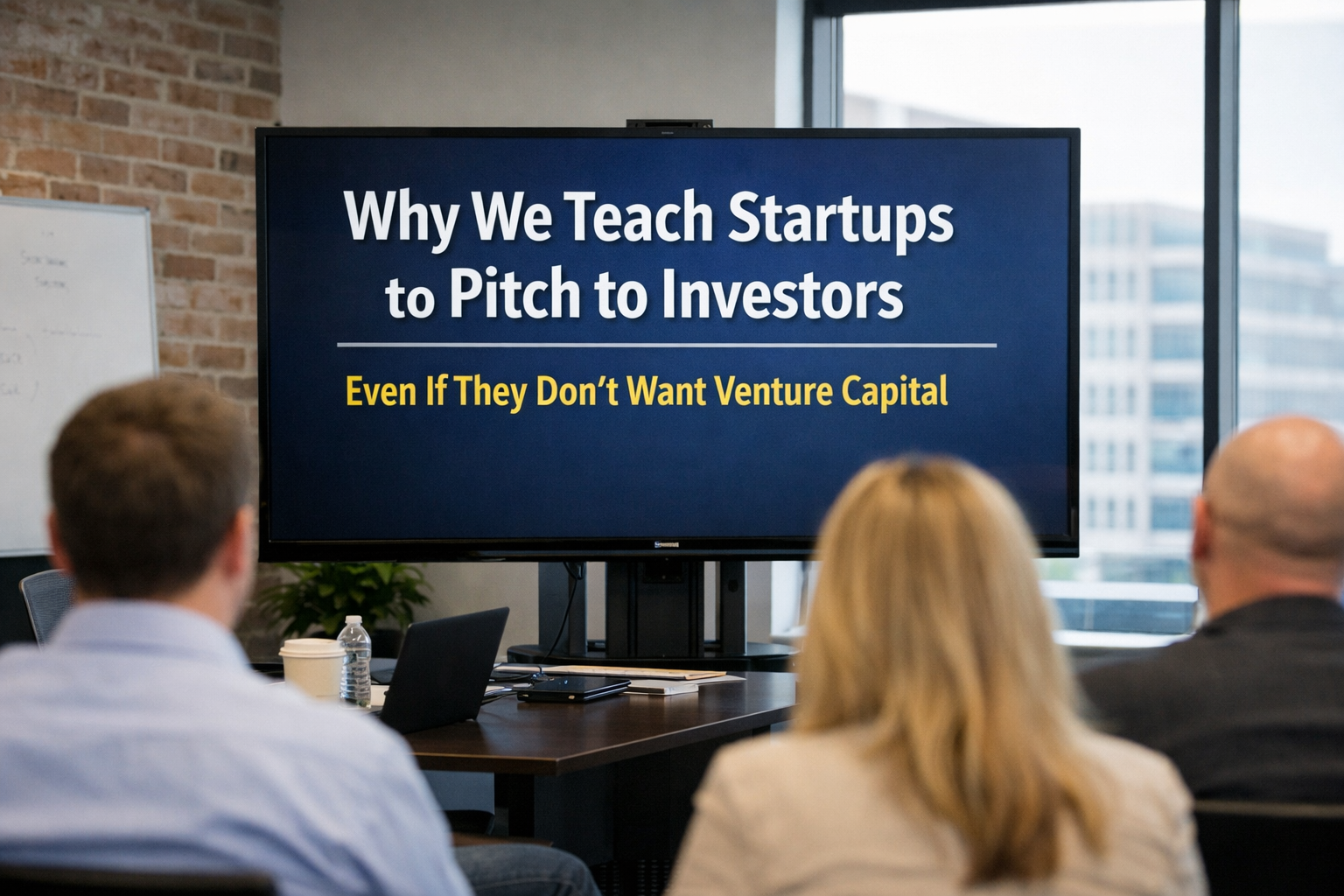
I realized this week, that this is a discussion point I have with almost every founder, and yet I’ve never bothered to write it up. Every founder. Particularly in our work in Founder Institute, when teaching or mentoring dozens of founders in the same room, the question is always posed, “why are we working on pitching to investors, if we don’t want VC?”
Many startup founders love to say they “don’t want VC.” Sometimes they’re right; more often, they’re confusing not wanting dilution with not needing discipline. Those are not the same thing, and pretending they are is one of the most reliable ways to build a company that survives just long enough to disappoint everyone involved.
We teach startups to pitch to investors because convincing a venture capitalist to allocate millions of dollars is categorically harder than selling a product to an early customer. That’s not an insult to customers; it’s an observation about risk, incentives, and asymmetry.
Many of you have heard that you need to know your audience so that you might speak to them and their needs, but what I’ve learned over the years and thousands of startups, is that better, is appreciating in startup pitch not your target audience or objective, but rather, pitching what you’re doing in such a way that it is appealing to everyone. Investors are the peak challenge to win over so we orient your thinking (and pitch) to appealing to them because if they’d be on board, everyone else is relatively easy
A customer is buying relief from a specific pain today. A venture capitalist is underwriting years of uncertainty, competitive response, capital structure, execution risk, and the probability-weighted outcome of a meaningful exit. If you can’t articulate why your company deserves that kind of commitment, you almost certainly don’t understand your own business as well as you think you do. And hold in your mind as you read on, I’m not suggesting that you need or should want venture capital; frame that meeting their needs orients your brain, priorities, work, and talking points, to what conveys a valuable opportunity.
Early customers are forgiving. Investors are not. A customer might buy because the product scratches an itch, the founder seems competent, or procurement needed to spend a budget before year-end. Investors assume customers are easy. In fact, if a founder can’t sell to customers, investors usually stop listening immediately. Selling is table stakes. What investors are evaluating is whether sales can compound into a durable company.
Besides, in overwhelmingly most startup pitches, we tend to hear founders selling more than pitching – you want to show the product, explain the value to customers, and wrap up with an ask that almost sounds like you really just want people to *buy* what you’re doing. That, in and of itself, is a SALES pitch, not a startup pitch; while you are still holding in your mind that a startup pitch is not because you NEED (or want) funding, it’s to pitch the startup, not the product.
That distinction matters because early revenue actually does not equal value creation; this is where a lot of startup mythology falls apart. Easily understandable because only 1% of you (+/-) will even ever get funding, you’re bombarded with advice to focus on the customer – and so you do orient your thinking that way. But you can sell something useful and without the bigger picture, be building a company that will never scale, never defend itself, and never justify further support (or funding). A handful of customers can validate that a solution works; they do not validate that a business works. Growth, resilience, and survivability are different problems entirely.
When an investor listens to a pitch, they are not buying the product. They are buying a theory of the future. That theory has to account for capital efficiency, competitive advantage, and the mechanics of scaling. It has to explain why this company, in this market, with this team, can grow faster than alternatives and defend its position long enough to produce an outcome that matters. That outcome is usually an acquisition or IPO large enough to return the fund, not just cover payroll and make the founders feel clever.
Startup pitching (a good startup pitch) forces clarity. Investors expect things like financial responsibility not as a moral virtue, but as a survival trait. They expect founders to understand unit economics because capital misallocation kills companies faster than competition. They expect a capable team because lacking that, you will fail. They expect a defensible advantage because markets copy everything that works. They expect partnerships because scale rarely happens in isolation. And they expect a plausible path to exit because liquidity is the entire point of the exercise.
None of that is required to close your first few customers. In fact, customers often buy precisely because they don’t care about those things yet (they care that the solution works today). But customers are also not stupid. At some point, they’ll stop betting on companies that look like they might disappear. Enterprises, in particular, avoid dependency on fragile companies. A startup that cannot articulate longevity will eventually feel that hesitation in slower sales cycles, smaller contracts, or outright rejection.
The overlap between customers and investors: neither wants to rely on a company that is clearly going to fail. Customers may not ask for a cap table or an exit strategy, but they absolutely care about continuity, support, and roadmap credibility. Those are downstream effects of the same fundamentals investors interrogate upfront.
Why Pitch for Investors
Teaching founders to pitch to investors is not about pushing them toward venture capital. It’s about forcing them to confront whether they are building something that can survive success. The investor pitch is a stress test; it asks questions customers won’t, at least not until it’s too late to fix the answers.
You can see this dynamic play out in real funding events. When companies raise significant rounds, the story is never “we sold a useful product.” It’s about category definition, institutional adoption, and scale economics. In the recent Series A raised by Checkbox, for example, the narrative I interpreted centered on becoming a foundational layer for legal operations, integrating across enterprise systems, and turning institutional knowledge into scalable workflows. That framing is not a sales pitch; it’s not customer focused; it’s an articulation of why the company can grow into something durable and defensible.
That same clarity benefits founders who never take VC. A bootstrapped company that understands its economics, its moat, team that is really required, TAM/SAM/SOM, and its growth constraints will make better decisions about pricing, hiring, partnerships, and product scope. It will know when not to grow and it will know when to say no. Ironically, the companies most confident in rejecting venture capital are often the ones that could raise it, precisely because they’ve done this work.
So, we teach startups to pitch investors because the exercise exposes weakness early, when it’s still cheap to fix. It replaces vague optimism with explicit tradeoffs. It’s like a new business writing a business plan in that the exercise of doing it is almost more important than the plan itself. It forces founders to stop confusing traction with inevitability, and it makes painfully clear whether the company is being built to last, or merely to sell something for a while.
If pitching an investor feels harder than selling your product, that’s not a problem. That’s the point. The true questions to work out as a startup are whether your current decisions would still make sense if someone put a few million dollars on the table and asked you to make sure they get a substantial return on that investment. If the answer is no, what are you actually building? How long do you expect anyone else to trust it?


As a founder, have you ever said “I don’t need funding or I don’t want venture capital?” Read this ??.
Simple and perfectly framed as I’d hoped Tope. Thank you for sharing!
Yes!! This isn’t how to pitch investors, it’s why they are the high water mark you want to hit, to make everyone else easier to convert.
This makes sense! It’s not about being able to pitch in theory, but the ability to pitch ones own product/service with enough depth, clarity and long-term vision that someone else would agree with the profitability of the business, even if they didn’t care at all about what it provided, personally.
Being able to convince a veteran to have skin in the game—even if you don’t want their skin—confirms your viability.
Elliot Van Wie exactly. The number of times I’ve heard a pitch and thought…
But you can’t pull that off
Or, what about those competitors
Or, your GTM plan is too basic and isn’t going to work
You’re pitching to experienced people in order to find your gaps and address them
Filling out Guy Kawasaki’s 10 slide template and just running with it, is missing the point
For some founders, pitching sharpens thinking. For others, it can unintentionally erode it. Treating one communication style as universally “disciplining” risks (ABSOLUTELY IS) filtering out integrative, monotropic, systems-level thinkers; the neurotypes that are HISTORICALLY SHOWN to be well suited to building resilient, long-term companies. Zero-to-One minds are muted under lossy compression of forced translation methodology.
That’s not a motivation problem. It’s a fit problem.
It would be valuable to see more longitudinal evidence linking intensive pitch training to outcomes beyond fundraising; such as five-year company health, investor ROI, or organizational resilience. Without that data, performance-based filtering through pitch culture can become more about efficiency than effectiveness. Over time, this risks narrowing the pipeline of capable founders rather than strengthening it.
When there’s a lack of prep work or inexperience problem, this tracks. But those are not founders most are seeking.
Founder advancement marketplace MUST begin to think outside the pitch-box to build new gold standards that lead to validated outcomes.
This status quo ableism just ain’t getting us there. We ALL see that plainly in the statistics.
Carol good points and perspective but out of thousands of startups, I’ve never met a founder who isn’t missing something
Paul O’Brien That’s exactly my point.
Everyone is missing something. The question is whether our systems are designed to surface and support those gaps… or to filter people out based on how well they perform in one narrow communication format.
Pitch culture tends to reward founders who are already fluent in compression, performance, and abstraction under pressure. It often misses founders whose strength is integration, long-range systems thinking, and building durable infrastructure; skills that matter more over time than in a 3-minute narrative.
If the goal is long-term value creation, then the work isn’t just “find what they’re missing.” It’s: what structures help different kinds of high-capacity founders translate their thinking without losing it?
That’s the gap I’m focused on closing. Because ignoring it is snowballing the number of founders that end up erased in burnout collapse.
That title makes no sense, but I get the point sort of.
VCs are only one form of investor. So you pitch to all bc none who will listen to have conversations and learn.
One does owes a deck either, so to be candid. It does not need to be a pitch either again.
What one wants is conversations leading to insights and learning for the business itself from ALL potential stakeholders and knowledge sources. Suppliers, customers, customers’ customers, influencers, partners, all funding sources nd more.
Limiting this to VCs seems odd and misplaced. There too much of a focus on VCs as well in investing. There are many other funding sources, from investors like VCs, angels, angel groups, family offices, partners customers their customers, supplier, governments and more.
Point is – learn from everywhere you can nd then develop the context for your own startups or ideas to move forward…or maybe not.
Me? I never just ask for money. I ask for help. Opinions. Insights. Ideas. Feedback.
That’s what helps create a great startup and to even assemble a great team and finally to see who naturally wants to get invoked, including with money.
“We Teach Founders to Pitch to Investor Expectations Because…” Something like that better?
Paul O’Brien far far better. We soon wiIl grow and exit more businesses.
We’ve met with a bunch of universities. Poor. Ill experienced generally for the okay. Low salary, poor upside, very low vudgget. I mean less than $100,000 a year and even less than $6,009
As always, you’re dropping golden nuggets of knowledge and experience. Thanks for sharing. Paul!
You need to be able to articulate all the answers to the questions to demonstrate a sustainable business. If you need to get that feedback from VCs, do that. The best executors are not the best pitchpersons. And it takes a lot of time to learn how to pitch. So, I would opine to do that exercise to think throught the business plan and focus on execution. 5 year projections are never met and startups do a lot of pivoting. You always need to be thinking about that and telling a clear story. Obtaining lots of feedback is part of the process. But a new entrerpreneur does not what the bandwidth to everything. So heed this advice and factor it into your timeline appropriately.
It’s crucial to know how to pitch (well, broadly speaking “sell” your ideas really). But lately, I’ve been thinking it’s also good to know how to reverse pitch. Can you describe all the reasons *not* to invest in your startup clearly and articulately? If so, you can probably also sell the reasons to invest in your startup a lot more clearly. I’ve yet to see a perfect business. But there’s certainly *good enough to make money* while falling short of perfection.
Mark Biw I find upside down / backward thinking is always helpful. Often teach going through your pitch backwards to find holes