
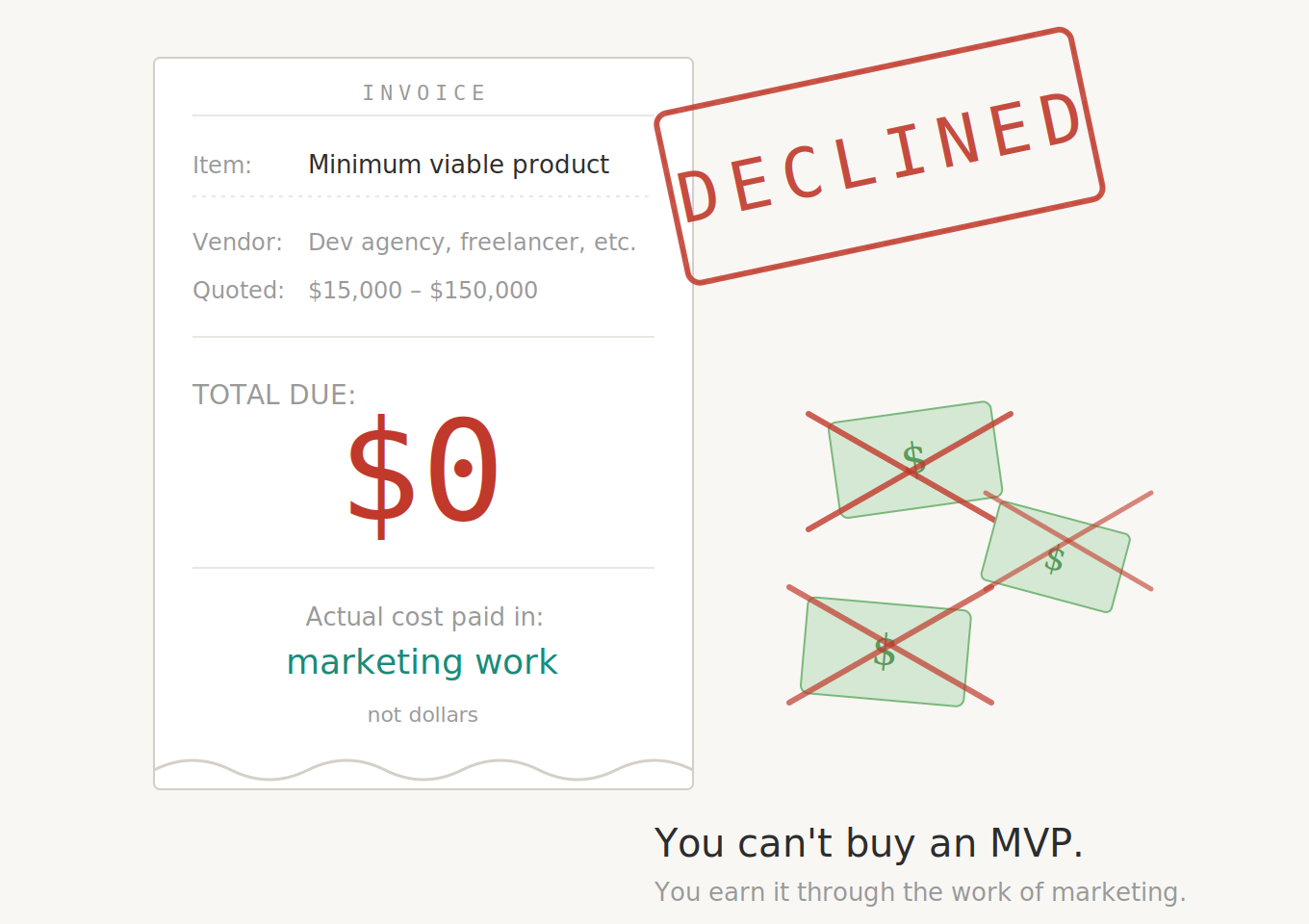
The average cost of building an MVP is $0. You read that correctly. Not “$0 if you squint,” not “$0 with an asterisk.” Zero dollars. Let me restate it clearly since I keep getting asked, “How much does it cost to build an MVP?” Nothing. If you’re uncertain of that answer, we have more evidence that the startup ecosystem has mislead how you think about what an MVP actually is.
The entire industry around “MVP development” has become a racket. Development agencies will quote you $10,000 to $50,000 for startups, and up to $150,000 or more for complex builds. Estimates land between $24,000 and $96,000, with an average time to market of four to five months. These are real numbers being charged to real founders who are spending real money to build the wrong thing. They are building solutions; they are not building MVPs. The distinction is not semantic, which I’m prone to push on; it is the single most expensive misunderstanding in entrepreneurship.
I wrote about this extensively in Lean Startup Is Wrong… or You Are, where I made the case that your MVP is not supposed to prove functionality; it is supposed to prove demand. Dropbox did not build file syncing software to test their hypothesis. Drew Houston made a video. A video. The waiting list went from 5,000 to 75,000 people overnight. That was the MVP. The software came later, after they had already proven people wanted it. But founders keep ignoring this, and agencies keep cashing checks, and the startup failure rate hasn’t budged in twenty years. The conventional wisdom says 90% of startups fail. It said 90% in 2002 when I started my first startup, and it says 90% now. If startup ecosystems and MVP developers were meaningfully delivering, that number would have changed. It hasn’t. Either the methodology is wrong or you’re doing it wrong; I wrote an entire book about why it’s not the founders.
Article Highlights
How Much Does it Cost to Build an MVP?
Your MVP is the minimum viable proof that you can convert a sufficient volume of paying customers (or at least willing-to-pay customers), competitively, for a thing you intend to build. It is NOT the thing itself. It is proof that the thing has a market. And more importantly, your MVP is proof that YOU can do the thing that is not obvious about you as a founder. This is where the two perspectives diverge, and where our conversation really gets useful.
“The minimum viable product is that version of a new product which allows a team to collect the maximum amount of validated learning about customers with the least effort.” – Eric Ries; Lean Startup
Building on lean-manufacturing principles that originated at Toyota, early definitions of “viable” focused narrowly on whether something functioned – could it work at all? Ries meaningfully added the context of customers, but most seem stuck in the idea that proof of customer demand requires a developed solution while at the same time, I want to push your understanding further since what we’re attempting to build here is a company, not just a product for which customers will pay. Can your venture create the volume, competitively, from those customers in the market?
Like a mere idea for which founders are hoping to find investors to start, expecting an MVP to prove your *startup* is valuable, without establishing a competitive advantage and ability to grow while creating value, is wasting your time.
The Engineer Who Can Build Anything (but Can’t Prove Anyone Will Buy It)
You are the technical founder. You can code. You can architect systems. You can ship product. Congratulations; in 2026, so can a reasonably motivated twelve-year-old with access to ChatGPT and a free Replit account. The ability to build software is no longer a differentiator. I made this point in Michael Jackson and the Startup Delusion: Why Tech Isn’t What Creates Value; the startup world confuses building with creating value, and they are not the same thing. Jackson did not walk into a studio hoping to figure out the music; he had the entire arrangement in his head before the session musicians touched an instrument. He was the product, and the product was marketing, brand, storytelling, and influence packaged into something the market wanted.
You, the engineer, have the opposite problem. You can build the instrument. You can tune it perfectly. But nobody is showing up to the concert because you never figured out how to fill seats. Your MVP, then, is not another app; your MVP is proof that you can generate demand and convert it. The entire point of your minimum viable product is to demonstrate the capability you obviously lack: marketing.
Here is what that looks like, and it costs nothing:
A website with a landing page. Not an application and not a platform, a single page that describes the problem you solve, who you solve it for, and a button that says, “Sign Up” or “Join the Waitlist” or (better yet) “Buy Now” at a price point. You can build this with Carrd for free, with WordPress for free, with a static HTML file hosted on GitHub Pages for free. The page does not need to do anything other than capture intent. If 1,000 people visit and 3 sign up, you have learned something. If 1,000 visit and 300 sign up, you have learned something radically different. If nobody visits at all, you have learned the most important thing: you have no idea how to get appropriate attention, which means you have no business building a product yet. Why would you?? Your *startup* will fail.
A newsletter. Substack is free. Buttondown is free. You start writing about the problem space your startup addresses. Not about your startup (nobody cares about your startup); about the problem. You build an audience of people who have the problem you intend to solve. If you cannot get 500 people to subscribe to a newsletter about the problem, you have no evidence that 500 people will pay for your solution to that problem. The newsletter is the MVP. It proves demand exists and that you can reach it.
A social media group or community. A Facebook Group, a Discord server, a Slack community, a subreddit. You build a gathering place for people who share the pain point you are targeting. You moderate it. You provide value. You watch what they talk about, what they complain about, what they wish existed. This is not “building in public”; this is market research that doubles as audience development. It costs zero dollars. If you cannot get people to join a free community about the problem, why would they pay for your solution to it?
You can’t do this?! What ethical compass is driving you forward thinking that anyone should take a risk joining you, let alone investing in you, if all you can do is invent something and put it out there? That’s not a company!
A “Buy Now” button that does not yet deliver. This is the part that makes many leery of how to do this, and I love it. Put up a landing page with a price and a purchase option. Use Stripe (free to set up, you only pay when someone actually pays you). Use Gumroad. Describe what you intend to build, price it, and see if anyone pulls out their credit card. If they do and you cannot yet deliver, you refund them, thank them, and now you have validated demand at the highest possible level: someone was willing to give you money. That is not a survey. That is not a “great idea!” from your mom. That is a credit card. Peter Drucker observed decades ago that only two things create value in business: innovation and marketing. As I explored in How, Not Just Why, Startups Fail, marketing is the distinguishing work between those two, and if you have to sell, you have not done the marketing to make selling unnecessary.
For the engineer, none of these things require writing code. That is the point. Your code is not what is in question. What is in question is whether you can find customers, create demand, build an audience, and convert interest into revenue. Proving that is your MVP, and it costs you $0.
The Business Founder Who Can Sell Anything (but Can’t Prove They Can Get It Built)
Now flip the lens. You are the MBA, the salesperson, the marketing whiz, the “ideas person.” You have domain expertise, industry connections, maybe even customers who have told you they want what you are describing. You have a pitch deck and a Canva account and a LinkedIn following. What you do not have is a product. And the question every investor, advisor, and potential cofounder is silently asking about you is: can this person actually get something built, or are they just another talker with a slide deck?
No one funds ideas!!!!!
Your MVP is not a polished application either but your MVP has to prove that you can translate your vision into something functional. Not perfect, not scalable, not enterprise-grade. Functional. And in 2026, the cost of proving that is also $0, because the tools available to non-technical founders have obliterated excuses.
AI-powered builders like Bolt.new, Lovable, and Replit all offer free tiers that let you describe an application in plain English and generate working code. These tools provide free tiers with daily or monthly credits where you can build and deploy simple apps without paying. You describe what you want, the AI generates it, and you have a functional prototype to put in front of users. Is it production-ready? No. Does it need to be? Absolutely not. It needs to prove that you can get something built. That is the capability in question for you.
OpenClaw, the AI agent framework that went viral in early 2026, surpassed 100,000 GitHub stars and became a viral tool in the developer community. You can run it with free-tier AI models through Ollama for literally zero cost. It can write code, manage files, automate tasks, and build functional prototypes. The barrier to “getting something built” has never been lower in human history.
But the same landing page and newsletter strategy applies to you too, just for different reasons. When you build a landing page with a sign-up and payment option, you are not just proving demand (which you probably already believe exists because of your domain expertise). You are proving that you can create something tangible. A website that captures emails and processes payments is a built thing. It is small, but it is real; it is functional. It demonstrates that you can go from concept to execution without needing a CTO on day one, and that signal matters enormously to investors and potential technical cofounders.
Marketing is not something you tack on after product development. Marketing is the lens through which product development happens. For you, the business founder, the twist is that building something (anything) is the lens through which your marketing credibility gets proven; you need both, and you can start both for free.
The MVP Mistake Everyone Makes
The mistake is thinking the MVP is the actual solution. It is not. It was never supposed to be. Eric Ries defined it as the version of a new product that allows a team to collect the maximum amount of validated learning about customers with the least effort. Somewhere between Ries writing that and founders reading it, “least effort” got interpreted as “limited version of the full product” instead of “not the product at all.” A 2018 study found that startups using MVPs incorrectly focus on the product rather than the business model, which limits learning and prolongs time to market.
Steve Blank, the intellectual godfather of the entire movement, never said “build a product, then validate it.” He said, “get out of the building.” As we explored together in Better Startup Idea Validation, overwhelmingly most founders do not actually do this. They Google some stats, talk to five friends, call it customer discovery, and then burn three months building something nobody asked for. Worse, as I pointed out telling you to Stop Trying to Validate Your Startup Idea, the best founders are not looking for affirmation; they are searching for the truth. Validation is the wrong frame; invalidation is the useful one. You should be running at every wall to see which ones collapse under pressure, not looking for the walls that hold you up.
The engineer needs to prove they can attract and convert customers: A landing page, a newsletter, a community, a payment button, done with free tools, proves that. The business founder needs to prove they can get something built: AI app builders, open-source agents, no-code platforms, all free, prove that. In both cases, the thing you built is not the solution you hope to bring to market. It is proof that you are capable of doing the thing that is not obvious about you. The engineer proves they can do marketing. The business founder proves they can ship product. The solution comes later, after you have earned the reason to build it by demonstrating you can do everything we perceive you can’t.
The notion that an MVP costs $15,000 to $150,000 is an artifact of founders who have been taught (badly) that the MVP is a stripped-down version of the product. The MVP is a stripped-down version of the business. A landing page that captures intent. A newsletter that builds audience. A community that reveals pain points. A payment button that tests willingness to pay. A prototype built with AI tools that proves you can execute. None of it costs money. All of it costs effort. And the effort is the point, because the effort itself is what demonstrates to investors, cofounders, and the market that you are not just another founder with a dream and a pitch deck and absolutely no evidence that any of it will work.
Marketing is leading startups again, faster than you think, because the rise of AI, no-code tools, and open-source platforms has commoditized product development. A single founder can now build and launch a product that rivals large corporations (you can argue I’m wrong, but I’ve seen 6 no-code founders do that very thing, just in the last few days). The cost advantage is gone and the technical moat is gone; what remains is whether you understand the market, whether you can reach it, and whether you can convert it. Proving that is the purpose of an MVP.
If you are struggling with what that looks like for your specific situation, the question to ask in the comments is not, “what should I build?” but “what about me, specifically, does the market have reason to doubt?” Answer that, and you will know what your $0 MVP needs to be.
Well and THOROUGHLY stated, Paul.
Over the years, the ignorance of this has become increasingly grating… hearing software developers *allowed* to come into incubators, mentor sessions, etc. and propose their PAID services to build an MVP, pisses me off.