
Despite countless articles and every startup program explaining how to validate a startup idea, one of the (surprisingly) still frequently most asked questions is how to validate a startup. Reading the tea leaves, that tells me not that people actually don’t know (conventional wisdom is “talk to customers”) but rather, that that advice is less than ideal. And if I’m to hazard a guess, less than ideal is accurate because well, I agree; I’m well known for pointing out that a startup with customers is easily misled and hardly competitive or capable of scale, but more to the point, perhaps you don’t know how to get at a sufficient number of customers… saying “talk to customers” is great if you have the depth of a community or audience that makes that possible. Startup idea validation doesn’t seem easy (but it is).
Let me give you 5 things to consider better:
Article Highlights
1. Do you know what you’re doing?
The most successful founders are roughly 44 years old and the reason for that is that experience trumps everything.
When I hear people asking about idea validation, I think of the thousands of ideas I hear every year and it occurs to me in 99% of cases, common sense can tell us if an idea is valid or not.
- A CRM that favors social media profiles and engagement over email addresses and sales lead engagement? Good idea. Common sense.
- A blockchain based AI platform for promoting events via mobile? Come on. Just saying that makes it obviously not.
Don’t know what you’re doing to know that it’s probably a good idea? Then it’s probably not a good idea simply because you aren’t experienced and oriented to doing it (which happens to be a primary cause of startup failure). Which is to say of an idea, you should know… you should be moving forward already to validating what’s uncertain and proving that you can accomplish it.
2. Have you done the marketing?
Overwhelmingly most founders don’t, and troublingly, too many mentors and investors who don’t have a clue what marketing means, perpetuate this horrific notion that marketing means promoting something you have.
Marketing is the work of the market to determine what you should do. So, in this context, have you:
- Studied competitors?
- Set up a SWOT analysis
- Done the market research about trends
- Evaluated where to build and how?
- Determined the channels through which to find customers, pricing, and points of conversion?
Most founders don’t do any of that and frankly, disregarding it is why 90% of startups fail (a ridiculously bad rate of performance we should all be ashamed of, driven entirely by founders pushing to do something that clearly isn’t going to work).
3. Have you talked to PEOPLE (not customers)?
Talking to customers requires that they are unbiased. They’re not.
If you present a solution to a problem, they’ll tell you it’s a good idea. But will they switch? Will they pay?
More, founders are horrifically bad when it comes to overcoming their own bias and perceptions. How do you overcome that? How do you overcome your own bias and perception when customers agree that it’s a problem and opportunity? You talk to 12-year-olds. You talk to 70-year-olds. You talk to hundreds of random people, and you learn from them what NOT to do – because people aren’t dumb.
Think people are dumb? See #1. Are you REALLY? Or can you rather reasonably work out if an idea is worthwhile?
People aren’t dumb. Ask if it’s a good idea, ask what’s wrong with it, ask why it won’t work, and I guarantee you, 200 conversations with a diverse set of people are more valuable than 10 customers who did little more than reassure you that your idea is a good one.
Now, if you properly built an MVP, having already spoken to lots of people, and have that MVP live to PROVE that customers will convert, then start talking to customers. But I doubt you’ve done that, most of you don’t build an actual MVP, you built the solution you want.
Besides, as a startup, if you have customers but didn’t work out if and how to fund operations, scale, and compete, your customers are worthless when you go out of business. You don’t need customer proof unless you have an obviously bad idea, and you should have worked that out before building anything.
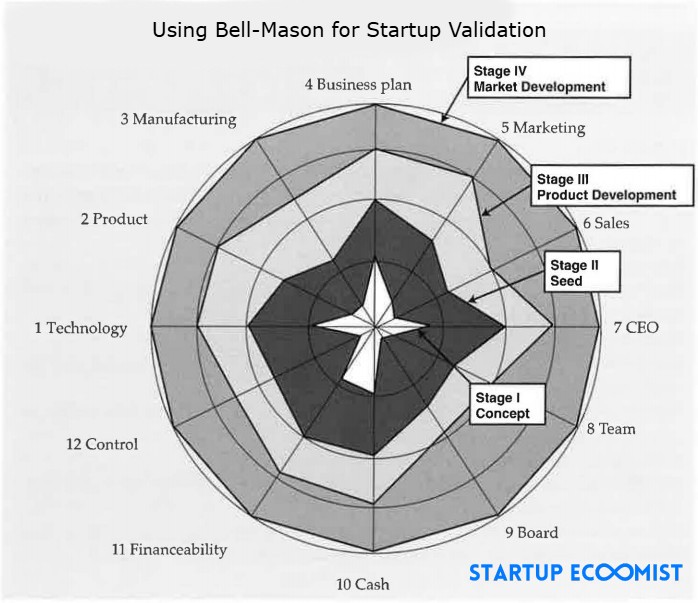
4. Use the Bell Mason Diagnostic
This is a sophisticated one, so bear with me and I’ll give you an easy option next.
Go through this list and evaluate YOUR competence on a scale of 0 to 5 where 0 is incompetent and 5 is best in the world (odds are you’re not 5 on anything):
1. Technology (Feasibility)
- Technology): The foundational tech innovation and whether it is viable.
- Product: The step beyond raw tech—how it transforms into a usable product.
- Manufacturing: The ability to produce at scale efficiently.
2. Product (Usability)
- Business Plan: The strategy behind turning the product into a viable business.
- Marketing: Defining how to bring the product to the right audience.
- Sales: Demonstrating real user interest and conversion strategies.
3. Market (Scalability)
- CEO: The leadership’s ability to drive market adoption and strategy.
- Team: The operational force behind scaling the company.
- Board: Governance and strategic oversight for sustainable market growth.
4. Organization (Sustainability)
- Cash: Financial resources to sustain and grow operations.
- Financeability: Investor confidence and ability to raise further funding.
- Control: Systems and governance to ensure operational efficiency and regulatory compliance.
We map this on a spider graph; you can check it out here: Your Startup Pitch is Bad; Let me Explain How I Know. The more 4s and 5s, the larger the graph shows your potential (good idea). If you have a small shape plotted on the graph, bad idea.
5. AI it (but not on your own)
This is something AI is actually very useful for. Let me give you two paths.
The smartest would be just using FounderGPT, here
Already trained to operate based on researched startup methodology, they have there an Idea Assessment Coach and an Idea Discovery Guide freely available, meaning you can prompt it things based on all the stuff that you need to know as a founder (but likely don’t). Don’t reinvent the wheel here, just ask the AI made for it. By the way, they also have a Competitor Analysis & Market Research Assistant which tackles consideration #2 a bit more for you.
Not sold on free and already trained for it? Build your own.
Set up your own Board of Advisors as a Project in ChatGPT (project means you’ve added instructions to direct how it operates and then the chats are self-contained within that project). So, you’re project is your Board.
With the right “Board Members” programmed into your AI (a marketer experienced in your sector, a sales person who would know your customers, an investor who knows the innovations, etc.), you have an AI designed to ask any question and get more meaningful advice than you’d get asking Grok (or even an actual Advisor) directly. Here’s how
Any one of these is better than what 99% of founders do. The smart play is doing all 5.


Paul O’Brien
This is such a sharp breakdown. Too often, founders confuse “talking to customers” with real validation. Real validation comes from competence, market insight, and testing assumptions, not just reassurance.
At SimpleeCreate, we apply these principles every day. As we prepare to launch new workflows in 2026, we’re focused on building processes that help teams iterate smarter, test ideas rigorously, and produce high-quality branded content that actually works in the market. Validation, focus, and execution are everything.
Curious
from your experience, which validation approaches separate ideas that truly scale from those that fail early?
Vladimir (Zev) Rigenco thank you! Not following your question though ? Um… these 5 ?
Great insights, Paul! It’s like trying to find the right mixtape for a road trip or new girlfriend – sometimes you need to test a few tracks before you hit the sweet spot.
Validating ideas is all about tuning into the right feedback. Let’s keep the conversation going and make sure we’re not just jamming to the same old tunes!