
You learned something in elementary school that ruined your ability to communicate as a founder: Who, What, When, Where, Why, and How. That’s the order they taught you, and it’s wrong. Not wrong in the sense that those aren’t the right questions (they are, and they’re the First Principle questions that matter), but wrong in the sense that the priority in which you were taught to think about them is out of order for anyone trying to build, sell, lead, or fund a venture. Most founders walk into a room and say what they’re building and how it works; and then they wonder why the room doesn’t care. The room doesn’t care because you skipped the part that makes anyone care.
Years ago, I wrote Raising Capital: The Perfect Startup Pitch to make a point that has become more clear since; six elementary questions every founder must answer are Why, Who, When, Where, What, and How, in that order. That article laid the groundwork of the startup framework; now, a spreadsheet, the methodology, and the thinking behind it, because since then I’ve refined a framework that does more than just organize a pitch. It organizes a startup. It produces your mission statement, your vision, your value propositions, your culture, your pitch deck, your elevator pitch, and your startup narrative, all from one living document. I’ve used this with thousands of founders, but I’ve always hesitated to write it up; it works, but my experience with it is in person, walking through it, answering questions, and teaching. It works because it forces you to answer the questions your brain already knows how to ask; it just reorders the priorities to match reality instead of the second-grade lesson that oriented the way you think.
Article Highlights
The Startup Framework
Having taught this again just this week, let me share it with you as best I can try, here. What happens in person is that founders work through this with me, and I can see the light bulb go off in faces as it dawns on people why the Problem / Solution oriented elevator pitch fails. If you don’t arrive at that conclusion through this article, let me know in the comments, reach out, and let’s talk about what you’re working on so I can further refine how this might reach others.
The framework lives in a three-tab spreadsheet. Tab one is the Worksheet, where you answer the questions. Tab two is Mission / Vision / Values, where those answers translate into the guiding principles of your organization. Tab three is Pitching, where all of it maps to Guy Kawasaki’s 10-slide pitch deck and becomes the narrative you take into the world. If you skip straight to tab three (and most of you will try), you’ll produce the same garbage pitch deck you already have. This is sequential work. It’s also iterative work; you will go back and forth, refine, contradict yourself, realize you don’t actually know the answer to something you thought was obvious, and that discomfort is the whole point.
The Worksheet: Answering What You Think You Already Know
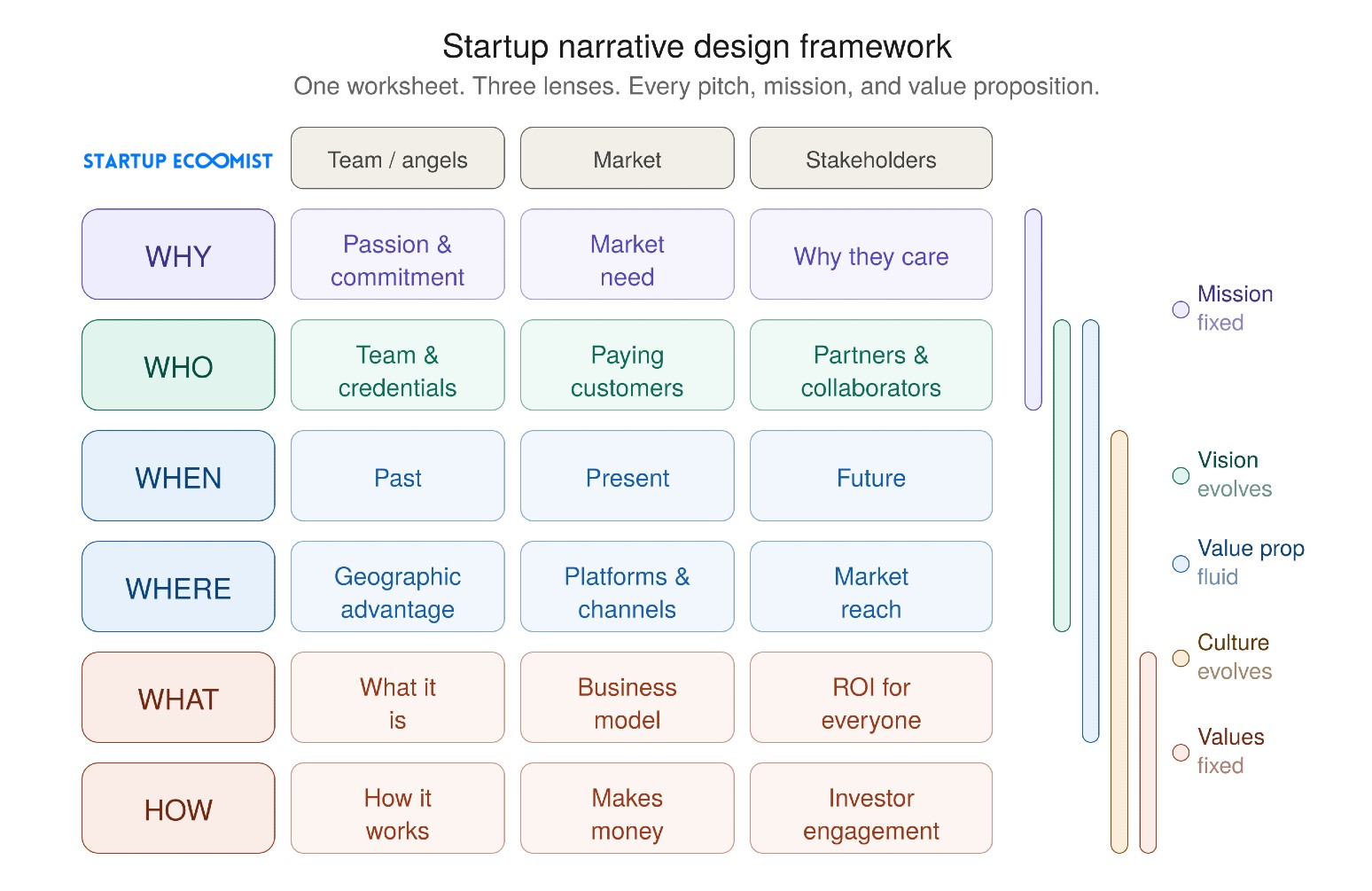
Let’s create your own: the Worksheet is a grid with six rows and four columns. The rows are WHY, WHO, WHEN, WHERE, WHAT, and HOW. The columns shift the lens from internal to external with the first column just being your row labels. Next to that, the first column of the work is about your team (and by extension, your earliest believers and angel investors). The second column is about your market (customers, demand, the people who will pay you money). The third column is about your stakeholders (advisors, partners, supply chain, community, industry, and investors).
Think of it like a Rubik’s cube where each face represents a different audience. Now, you tend to try to speak to your audience but because your cube is all mixed up, you never present a cohesive side to anyone; no one can discern the cube itself. What we need to uncover is that the underlying structure is of your venture is the same set of questions regardless of the side presented.
The goal is not to write essays. The goal is to fill in each cell with the minimally relevant information that makes that one intersection clear. One box. One audience. One question. If you can’t say it concisely, you don’t understand it yet. Your startup has a story problem and that story problem almost always traces back to a founder who has confused complexity with depth.
WHY is the first row because it’s the row that determines whether anyone in the room leans forward or checks their phone.
- Column one: why are you and your team passionate about, committed to, and experienced with what you’re doing? This is not a mission statement (yet). This is the raw, honest answer.
- Column two: why does the market need this? This is where your Problem/Solution Statement lives, but I want you to think about it as market need, not just “a problem someone has.” Consider existing alternatives. If nothing exists that does what you’re proposing, ask yourself if the absence of a solution is evidence of a problem or evidence that nobody cares.
- Column three: why will stakeholders care? Stakeholders are not just investors. They’re advisors who will give you time, partners who will integrate with you, communities that will support you, and yes, eventually, investors who might fund you. Why would any of those people care about what you’re doing?
Simon Sinek made a career out of telling people to start with why, and while I think his framing has become a bit of a bumper sticker at this point, the underlying logic is sound. People don’t buy what you do; they buy why. The problem is that most founders think their “why” is their personal passion story, it’s not. Your why has three dimensions (team, market, stakeholders), and if any one of those dimensions is empty, your venture has a structural weakness that no amount of product development will fix.
WHO is the second row, and it matters more than most admit because it either gets buried in founders not being confidence in themselves or their experience (i.e. imposter syndrome) or the lack of really understanding their market.
- Column one is team: document completely your background, experience, skillsets, roles, former companies, and the commitments of your team. Not a resume. An argument. Why are these specific humans the right humans to execute this specific opportunity? Techstars famously reinforced that team is the only thing that matters, and yet, as I’ve pointed out repeatedly, most pitch decks stick the team slide at the very end as though it’s a footnote.
- Column two is customers: describe, as specifically as possible, the people who will pay money for what you’re doing. Not “small businesses” or “millennials.” Real people, with real behaviors, in real contexts, spending real money. There could be more than one group.
- Column three is partners: companies, industry collaborators, educational institutions, anyone who could support or amplify what you’re doing.
WHEN splits into a grid within the grid. You need to address both your market and your startup across past, present, and future. Most of you fail to do this in as much as this is how you shape the evidence that you know what you’re doing; you know the past and future of your market, and have aligned what your startup has, is, and will be doing accordingly.
For your market: what’s the history of this space? What companies, technologies, and investors have shaped it? What does it look like right now, the major players, the emerging ones, the technology in place? And what’s your assessment of where it’s going?
For your startup: what have you accomplished so far? Where are you right now (and be honest, brutally so – this framework is not a sales pitch to make you look good! These are the facts)? And what does the future look like in stages? This is where you define what success looks like and, critically, what an exit would entail. Timing is one of the most overlooked variables in startup success. Founders routinely fail to communicate the market dynamics that make now the right time for their venture. Bill Gross, founder of Idealab, analyzed hundreds of startups and found that timing was the single biggest factor in success, accounting for 42% of the difference between success and failure (more than team, idea, business model, or funding combined). His TED talk on the subject has been viewed millions of times, and yet most founders still can’t answer the question “why now?”
WHERE has three dimensions (still our three columns). Geographically: why are you located where you are? What advantages does your city, state, and country provide? This isn’t about bragging on your coworking space; it’s about demonstrating that you understand the resources, talent, industry connections, and community that your physical location provides. As explored in why where matters and the role of shared philosophies in industry formation, your location is an argument about your venture’s viability, not a line item on your pitch deck. Platforms: where does the market connect with you? Your website, your app, your social channels, your code repositories, your physical stores. Document all of them. Market: where will you find your customers and partners, how will you reach them, and how will they find you?
You might notice now, if my explanation of this is clear, that while our second column of information is oriented to the market, and our first rows of that column are about the customer and market, it’s here in asking where, that we find the market in the third column. This is because our columns are setting up the talking points to orient your story to what needs to be established and proven to be meaningful to the next audience. That third column is the stakeholders and investors… the second column is the market itself, so in asking about your startup, Why and Who, we need to know that to go after the right audience. Our investors and stakeholders, need it established such that now you explain Where they’re found and how you’re going after them.
WHAT is the row that every founder wants to lead with and shouldn’t. I know you do this, and you know you do this; you introduce yourself or start your pitch by introducing the startup and telling us what it does. I want you to hold that I mean to say this kindly, though it might not seem nice, “we don’t care. (yet)”
- Column one: now you can explain what you’re doing. What your business is. What it does. This is usually what you know best and what you blurt out to people over coffee, which is precisely why it doesn’t belong at the top. Without the preceding context, “what” is just a feature list.
- Column two is the business model, and here’s where founders consistently screw up: your business model is NOT just how you make money. Explain the entire cycle, from how people discover you, to how they buy, to how you deliver, to how other parties and technologies are involved, to how you maintain customer relationships. If you can’t map the full loop, you don’t have a business model; you have a revenue hope.
- Column three is ROI: what is the return on investment to everyone involved? Everyone means you, your advisors, your partners, your stakeholders, and your investors. How will each party derive value back from the effort, time, reputation, work, and capital they invest?
HOW comes last because it’s the least important question for any initial conversation, which is the opposite of what 90% of founders believe.
- Column one: translate what it is into how it works. This is where mockups, demos, and walkthroughs live.
- Column two: get as detailed as possible about making money; profit margins, lifetime value, the various costs that distinguish how customers pay you and what that results in.
- Column three: how do you find, connect with, appeal to, work with, and deliver returns to investors? And notice, “investors” here doesn’t necessarily mean venture capitalists. These could be business partners, grant agencies, or whatever form of capital is put to work on your behalf. As I noted in why we teach startups to pitch to investors even if they don’t want venture capital, the exercise of thinking through investor expectations is a stress test for your entire business, not a fundraising exercise.
You fill this out. Then you go back and revise it. Then you realize that something you wrote in the WHEN row contradicts something in the WHO row, and you fix both. Then someone on your team reads it and points out that your WHERE doesn’t support your HOW, and you rethink your go-to-market. This is a living document. If you treat it like a homework assignment you complete once and file away, you’ve wasted your time and mine. Your spreadsheet should look something like this.

Startup Mission, Vision, Values: Crafting Your Startup
That was our first worksheet. I encourage keeping it as a standalone worksheet because it serves as a living document that you should share with your team, advisors, and friends; looking at it, without your explanation, they should be able to completely understand what you’re doing, why, and how to help.
Create a second tab to start translating everything you just documented and into the guiding principles of your company. This isn’t an exercise in corporate platitudes; it’s a structural mapping. This structure matters more than most people realize, because there are five layers derived from the elementary questions, overlapping; they share rows which might help you appreciate that failing to elementary questions cleanly (i.e. the foundation) causes the failure of the rest of your structure as a venture. They cascade through the middle of the framework like shingles on a roof, and the pattern of that overlap is what makes this a living system instead of a checklist.
Your Mission Statement draws from WHY and WHO. Why you exist. Who you are and for whom. Your unwavering mission should be derived from why your team cares, why the market needs this, why stakeholders will engage, and who is involved in making it happen. A mission statement is not a marketing tagline. It’s the thing that doesn’t change even when everything else does. If your mission changes every quarter, you don’t have a mission; you have a mood. Mission is fixed.
Your Vision draws from WHO, WHEN, and WHERE. It overlaps with Mission at the WHO row and extends downward into the contextual questions. Vision explores how you will accomplish that mission for the foreseeable future, accounting for your team composition, your timeline, and your positioning. Vision changes as the company evolves, as your team changes, as you enter new markets or phases. A new CTO joins. You expand from Austin to New York. The three-year roadmap shifts because the market shifted. Vision evolves, and that’s expected, because the rows it draws from (who, when, where) are inherently dynamic through the columns of facts.
What we can also pull from this framework are your Value Propositions drawn from WHO, WHEN, WHERE, and WHAT. Notice the overlap: Value Propositions share three rows with Vision (WHO, WHEN, WHERE) and extend one row further down into WHAT. These are the messages you use to introduce and sell what you offer to different audiences. Value propositions are fluid. They change constantly and they should. What you say to a potential enterprise customer in Q1 is not what you say to a strategic partner in Q3. The underlying mission hasn’t changed, but the value proposition has to meet the specific expectations, interests, and goals of who you’re speaking with, right now. This is the layer most directly tied to sales and marketing messaging; it’s audience-specific by design.
Exciting about this is that it also uncovers your company Culture, drawing from WHEN, WHERE, WHAT, and HOW. Culture overlaps with Value Propositions at WHEN, WHERE, and WHAT, and extends further down into HOW. Culture is influenced by when you are in your company’s development, where you work, what you do, and how you do it. As I’ve explored in the relationship between philosophy, culture, and industry, culture isn’t something you declare in an employee handbook. It’s the emergent result of shared philosophies expressed through daily work. Your company culture draws up from what and how you work because it’s influenced by where you work. Now, you were probably thinking that your How facts seem to explain how the solution works, how the business model works, and how that matters to stakeholders, and you’d be correct. So how does that correlate with culture? Culture is oriented to how you’re willing to work, what you’re doing, and what you won’t do. For example, if your How about investor engagement establishes that you don’t want venture capital and you intend to bootstrap, or you that you are determined to stay focused on being a Social Impact oriented venture, that defines cultural qualities of the company. Culture evolves as the team changes, as the product develops, as the company grows. A 5-person team working out of a garage in 2024 does not have the same culture as a 50-person team in an office in 2027, even if the mission and values haven’t budged. This should become more evident in how this framework helps define your values…
Shared philosophies, Your Values, draw from WHAT and HOW. These are your unwavering philosophical commitments about what you do and how you’re willing to do it. Like the mission at the top, values at the bottom are fixed. You either believe in transparency, or you don’t. You either prioritize customer success, or you don’t. You either operate with integrity in how you handle investor relationships or you don’t. Values don’t bend to market conditions or team composition.
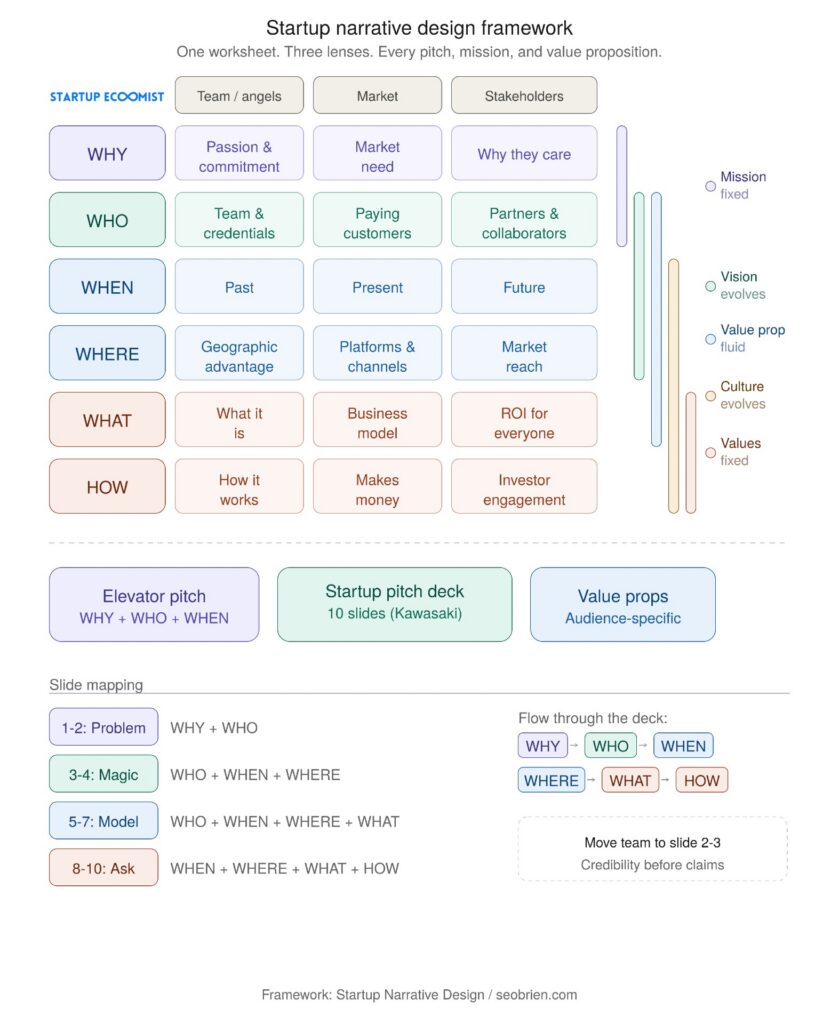
Now look at the shape of this. Overlapping like cascading brackets down the right side of the framework. Mission (fixed) covers WHY and WHO. Vision (evolves) covers WHO, WHEN, and WHERE. Value Propositions (fluid) cover WHO, WHEN, WHERE, and WHAT. Culture (evolves) covers WHEN, WHERE, WHAT, and HOW. Values (fixed) cover WHAT and HOW.
The top and bottom are the bookends; they’re permanent and they define the boundaries. The three middle layers (Vision, Value Propositions, Culture) share the middle rows of the worksheet and move, breathe, and adapt as the company evolves. WHO through WHERE is the most contested territory; three layers overlap there simultaneously, which is precisely why those middle elements are the ones that shift when a new co-founder joins, when you enter a new geography, when the market shifts.
Oliver Whitham captured a version of this alignment in a piece about tech culture that referenced this framework: philosophy drives culture, culture drives values, values drive vision, vision drives mission. The extremes are concrete. The middle evolves. And what you say to anyone (your value propositions) shifts with context, drawing from the most dynamic center of the framework while remaining anchored by the permanent layers above and below.
Take a look and then keep reading, there’s more!

The Startup Pitch Tab: Turning Answers into Narrative
A third tab, also separate on purpose, is where this framework delivers. It’s also where most founders start and shouldn’t, because pitching well only works when the first two tabs are done.
I have a guarantee for you: there is no accelerator in the world that teaches this. This was put together because they don’t. When you’re working through your 10 slide pitch deck, you’re taught to use an existing template, fill in the slides, and then work with advisors until it sounds right. It almost never does because no one works with you on the narrative design, the facts of the venture, and how they work together.
Put together three sections. On the left, the same six-row, three-column grid you already filled out. In the middle, your explanation of how those rows map to what you’ve written as your Mission, Vision, Value Propositions, Culture, and Values (the five layers you just derived in tab two). And on the right, we’re going to work out your Elevator Pitch and the Startup Pitch.
The Elevator Pitch is 30 seconds to one minute. The purpose is not to close a deal, secure funding, or explain your product. Recall that I nicely conveyed previously, “we don’t care (yet).” This is where that should ring true… can you imagine walking into an elevator with group of random people, and saying, “Hi, I’m Jane Doe, founder of My Startup, we fix this problem that I’m going to tell you about.”
I’m embarrassed for you even thinking that that’s how you start out your pitch. The brains of your audience are all thinking, “okay…? Get to what matters.”
The purpose is to engage anyone, any audience, such as a random person in an elevator, so that they want to talk more. Your neighbor. Your grandparent. The barista. Your auto mechanic. This is the message your entire team should be able to repeat in their sleep. This is the message that goes out in introductory emails, that you use at happy hour, and critically, that someone else should be able to repeat about you to accomplish the same outcome: making anyone want to know more.
How? Appreciate that overwhelmingly, most people don’t care HOW what you’re doing works. Most people won’t even care WHAT you’re doing; at least, not in 30 seconds. And WHERE? Where makes for great conversation but it won’t hook anyone with excitement. Your elevator pitch is a distillation of WHY, WHO, and WHEN into a single statement, nuanced slightly with your value proposition. The elevator pitch will change a little based on circumstances (when and where you’re giving it), so the goal is a WHY/WHO/WHEN core that is essentially always the same but can be adjusted depending on context. Notice how this bleeds just a bit into the value proposition layer; your elevator pitch should and will shift based on circumstances, which is exactly what a fluid value proposition is designed to accommodate.
The Startup Pitch is where the third tab of this framework explicitly maps to a 10-slide pitch deck, not as a pitching format but as a diagnostic tool. I like encouraging you use Guy Kawasaki’s but because, as I argued in The Better Startup Pitch Test, the Kawasaki deck’s value is not that it’s an ideal template; it’s that it forces concise thinking and exposes narrative gaps. Here’s how the mapping works:
Slides 1 and 2, the Problem/Opportunity (or “Problem Solution Statement”), draw directly from WHY and WHO in the framework. This is your reason for existing and the people who need what you’re offering. And here’s where the framework gives you an advantage that a blank slide template never will: you’ve already answered these questions from three perspectives (team, market, stakeholders), so your problem statement isn’t one-dimensional.
Slides 3 and 4, the Underlying Magic, draw from WHO, WHEN, and WHERE. This is where you demonstrate what makes you uniquely positioned to win. Your team’s background, the market timing, the platform and geographic advantages. If you filled out the worksheet honestly, this slide writes itself.
Slides 5, 6, and 7, covering Business Model, Go-to-Market, and Competitive Analysis, draw from WHO, WHEN, WHERE, and WHAT. These are the mechanics of your venture, informed by your understanding of the market’s past, present, and future, your customer and partner landscape, and what you’re actually built. Most Go-to-Market and Competition slides are garbage (click those to learn why); those weaknesses trace directly back to empty cells in this worksheet.
Slides 8, 9, and 10, covering Projections, Use of Funds, and the Ask, draw from WHEN, WHERE, WHAT, and HOW. The financial logic and investment thesis only make sense when grounded in everything that preceded. Most pitch decks fail before investors ever say no in part because your projections fail because you’ve been taught by some finance advisor to do arithmetic in a Pro Forma, instead of understanding and explaining causality. If you filled out the HOW row of the worksheet honestly (particularly the “Makes Money” and “Investors” columns), your projections have a causal foundation instead of a b.s. financial model that’s really rather irrelevant at this stage.
And then there’s the Team slide. The Kawasaki template puts it near the end so you can see why I like his approach but want you to reorient the final. The startup framework pushes you to move it to slide 2 or 3. If team is what most investors invest in (and it is), does it not make sense to establish credibility before asking anyone to evaluate the rest of your pitch? WHO is the second row for a reason. The audience should know who they’re listening to before they’re asked to believe anything else. This alone separates a pitch informed by this framework from the template-followers who put their headshots on slide 9 like an afterthought.
Notice the flow from beginning to end: WHY, WHO, WHEN, WHERE, WHAT, HOW. The pitch deck, done correctly, follows the same trajectory as the framework. You’re not arranging slides; you’re telling a story in the order that human brains are wired to receive it. Poor narrative positioning can reduce fundraising effectiveness by up to 70%, so cut it out! Look, even if my framework here is less than ideal, you know from experience that what you’re doing isn’t working, stop it.
This Is Narrative Design, Not Pitch Practice
The mistake nearly everyone makes is treating “pitch work” as though its purpose is to orient a founder toward investors and funding. Your Startup Has a Story Problem, good pitch work has never been about raising capital. It’s about organizational clarity delivered through narrative. The framework doesn’t produce a pitch for your audience, it produces a narrative about your venture that is coherent, complete, and compelling to everyone: your team, your customers, your partners, your advisors, your community, and yes, your investors (not necessarily VCs!).
You don’t pitch for difference audiences; you sell to different audiences. The distinction matters because a startup pitch is explaining the venture, not closing a customer or investor; selling, the value propositions of your work, are where resonance with audiences matters. Value propositions adjust, emphasis shifts, the elevator pitch nuances depending on context; but you can only make those adjustments when the underlying narrative is locked. If your story changes depending on who’s in the room, you don’t have a narrative; you have a collection of half-truths stitched together with hope, and everyone in every room can feel it.
A perfect pitch is one that works for everyone because the narrative underneath it is true, complete, and structurally sound. The criteria investors use to evaluate deals map almost perfectly to the criteria that make a story compelling to any audience. Team credibility. Market opportunity. Timing. Differentiation. Financial logic. Exit potential. These aren’t just investor concerns, they’re human concerns; if your story satisfies the most skeptical audience you’ll ever face (investors), it will work on everyone else, because as convincing a venture capitalist to allocate millions is categorically harder than anything else you’ll do in sales or marketing.
This three-tab spreadsheet is not a pitch deck template. It’s not a business plan. It is elementary school questions you’ve known your whole life, reorganized in the right priority, answered from three perspectives, and translated into the five organizational layers and narrative structure that make a company legible to the world. Your pitch deck is only capably accurate when these questions are answered. The mission statement is only authentic when these questions are answered. The value propositions are only resonant when these questions are answered. The culture is only coherent when these questions are answered. And the values only hold weight when they’re grounded in what you actually do and how you’re actually willing to do it.
If you’ve read all of this and you’re thinking about skipping the Worksheet and going straight to your pitch deck, go ahead; do not email me, I’m not going to help you with the same pitch deck junk that people me receive a dozen times a day. Go ahead, and keep wondering why the room doesn’t lean in. Or sit down with six questions you learned when you were seven years old, answer them honestly, and discover that the pitch was never the problem. The problem was that you never did the work that makes your story compelling.
That in mind, do email me. I run through this as a lecture at universities, a session in incubators and accelerators, and consulting with startups and companies. What cell in this framework can’t you fill out? That’s the gap that’s killing your venture. If you can’t figure out which one it is, that’s probably worth a conversation.
Curious how to share this with others? This is the visual that might be meaningful:

[…] healthcare, and ownership of intellectual property, and I’ve spent years writing about how culture is the emergent result of shared philosophies expressed through daily work, how team composition is the single greatest determinant of success or failure, and how the economy […]
Please add the Wheel of Startup to your framework, as a great pitch doesn’t make sense when the investment case is not there.
It’s designed to build things around Ideal Customer Persona’s, which means more effective validation. Also a routine to support with venture development so ventures are prepared to scale, and even more importantly: Founders can now check themselves on where they need to improve their venture + tech + team + products + growth strategy..
In other words: A simple tool that does help founders to recognize when not to pitch, while recognizing what work needs to be done over next 3-9 months before pitching.
If they really want, they can even share their progress over those 3-9 months with investors ‘in the open’ and so get funded 50% faster as investors can see their progress before being ‘pitch ready’.
In summary…. be customer-centric. Only their opinion matters.
The best pitch decks tell a story, not a business plan. Problem ? insight ? solution ? traction ? why now ? why us. Every slide should answer a question the investor is already asking in their head. The decks that land funding aren’t the most detailed — they’re the most compelling.
This hits hard. Most founders don’t fail because the idea is bad, they fail because they scale confusion. Awareness before product, engagement before scaling, proof before fundraising. The sequence changes everything. More founders need to slow down and build in the right order.
Ayobami Egbewole I think my experience has been *all* founders need to build in the right order; not just most